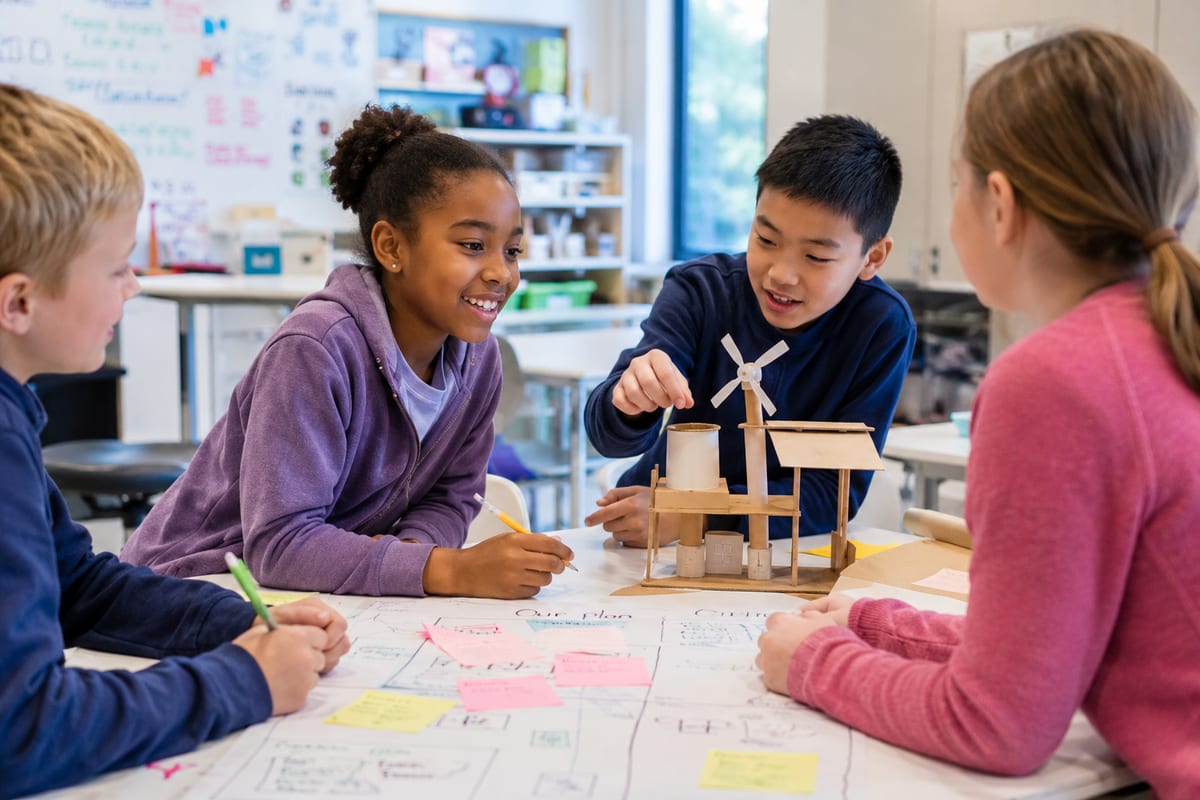
Entrepreneurial Skills Every Child Should Learn Before High School
When people hear the word entrepreneurship, they often picture Shark Tank pitches, startup founders, and billion-dollar companies.
But that's not what entrepreneurship means for children.
We don't believe every child needs to start a business. We do believe every child should know how to spot a problem, come up with a solution, communicate an idea, and have the confidence to try something new.
Whether a student becomes a teacher, engineer, nurse, artist, parent, business owner, or something that doesn't even exist yet, these skills will serve them well.
In fact, many of the abilities associated with entrepreneurship—critical thinking, creativity, communication, resilience, and leadership—are increasingly recognized as some of the most valuable skills for the future workforce. According to the World Economic Forum, analytical thinking, resilience, leadership, and creative thinking are among the fastest-growing skills employers expect to need in the coming years.
What Entrepreneurial Skills Should Children Learn Before High School?
The seven most important entrepreneurial skills children can develop before high school are:
- Problem-solving
- Communication
- Creativity
- Resilience
- Leadership
- Financial literacy
- Adaptability
These skills help children become independent thinkers who can identify opportunities, overcome challenges, and contribute meaningfully wherever life takes them.
Why These Skills Matter More Than Ever
The careers today's elementary students will enter may look very different from those available today. New technologies, changing industries, and evolving workplace expectations mean that success increasingly depends on a person's ability to learn, adapt, and think critically.
Research from the Organisation for Economic Co-operation and Development consistently highlights the importance of problem-solving, self-regulation, adaptability, and collaboration as key predictors of long-term success in education and life.
Rather than memorizing information alone, students benefit from learning how to ask questions, test ideas, communicate effectively, and persist through challenges.
Those are entrepreneurial skills.
1. Problem-Solving
Every successful entrepreneur starts with a problem.
The same principle applies to children.
When a student notices a challenge and begins looking for solutions, they develop critical thinking skills that transfer into every area of life.
For example:
A fourth grader notices that classmates frequently lose pencils. Instead of simply complaining, she creates a labeled pencil station that makes supplies easier to find and return.
The solution doesn't need to become a business. The important part is learning to identify problems and think proactively about solving them.
Parents can encourage problem-solving by asking questions such as:
- What do you think caused the problem?
- What solutions can you think of?
- What might happen if you tried that?
Children gain confidence when they discover they are capable of solving problems themselves.
2. Communication
Great ideas rarely succeed if nobody understands them.
Children need opportunities to practice expressing their thoughts, presenting ideas, asking questions, and listening to others.
Communication skills help students:
- Build relationships
- Work effectively in groups
- Advocate for themselves
- Share ideas with confidence
- Resolve conflicts constructively
Whether presenting a class project, participating in a discussion, or explaining an idea to a friend, communication is a skill that grows through practice.
3. Creativity
Entrepreneurship is often described as "connecting dots that others don't see."
Creativity allows children to imagine possibilities, experiment with ideas, and approach challenges from different perspectives.
Consider a student who wants to raise money for an animal shelter. One child might ask for donations. Another might create handmade bookmarks, organize a neighborhood event, or start a pet-themed craft sale.
Neither approach is necessarily right or wrong. Creativity expands the number of possible solutions.
Research consistently shows that creativity supports innovation, problem-solving, and adaptability—all essential qualities in an increasingly complex world.
4. Resilience
Ask any entrepreneur about their journey, and you'll hear stories about setbacks.
Projects fail. Plans change. Mistakes happen.
Children benefit enormously from learning that challenges are not evidence of failure—they are part of growth.
Imagine a student who spends weeks building a model bridge only to watch it collapse during testing.
The resilient response isn't "I'm bad at this."
It's:
"What can I learn from what happened?"
Resilience develops when children are encouraged to:
- Try again after setbacks
- Learn from mistakes
- Focus on improvement
- Persist through challenges
The ability to recover from disappointment may be one of the most valuable skills a child ever develops.
5. Leadership
Leadership is often misunderstood.
It isn't about being the loudest person in the room or having authority over others.
True leadership involves taking responsibility, serving a team, and helping others succeed.
Children practice leadership when they:
- Organize a group activity
- Help a classmate learn something new
- Take initiative during projects
- Volunteer in their community
- Follow through on commitments
Strong leaders listen well, communicate clearly, and create positive influence—skills that benefit students throughout life.
6. Financial Literacy
Many adults wish they had learned more about money while growing up.
Financial literacy doesn't require complicated investing lessons in elementary school. It starts with understanding how money works.
Children can learn through experiences such as:
- Earning money through chores or small jobs
- Saving toward a goal
- Comparing prices
- Creating a simple budget
- Running a small business project
For example, a child selling homemade bracelets quickly learns that supplies cost money and that profit is different from revenue.
Those lessons often stick far better than anything learned from a worksheet.
7. Adaptability
If there's one skill that defines successful people across industries, it's adaptability.
Technology changes. Careers evolve. Unexpected challenges arise.
Children who learn to adapt are better prepared to navigate uncertainty with confidence.
Adaptable students:
- Welcome new experiences
- Adjust when plans change
- Learn new skills willingly
- Stay curious
- Remain open to different perspectives
Rather than fearing change, they learn to see it as an opportunity to grow.
How Parents Can Encourage Entrepreneurial Thinking at Home
The good news is that entrepreneurial skills don't require a formal business class.
Many of the best opportunities happen naturally at home.
Parents can encourage these skills by:
- Allowing children to make age-appropriate decisions
- Giving them meaningful responsibilities
- Encouraging independent problem-solving
- Supporting creative projects
- Helping them set goals
- Allowing room for mistakes and learning
- Discussing how money works
- Celebrating effort and persistence
Small opportunities repeated consistently over time often produce the greatest growth.
What Educators Notice About Independent Learners
One pattern appears again and again in successful students.
They stop waiting for someone else to solve every problem.
Instead, they begin asking questions, exploring solutions, and taking ownership of their learning.
Independent learners tend to develop confidence because they've experienced success overcoming challenges. They understand that mistakes are temporary and that progress comes through effort.
Those habits often serve students long after specific facts from a textbook have been forgotten.
Frequently Asked Questions
Is entrepreneurship education only for children who want to own a business?
No. Entrepreneurship education focuses on transferable skills such as communication, leadership, creativity, resilience, and problem-solving. These abilities are valuable in nearly every career and life path.
At what age can children begin learning entrepreneurial skills?
Children can begin developing entrepreneurial skills in elementary school through age-appropriate opportunities to make decisions, solve problems, manage responsibilities, and complete projects.
Why are entrepreneurial skills important for students?
Entrepreneurial skills help students become adaptable, confident, and resourceful learners. They prepare children to navigate challenges, collaborate with others, and pursue opportunities throughout life.
Can entrepreneurial skills be taught at home?
Absolutely. Parents can foster entrepreneurial thinking by encouraging independence, supporting creative projects, discussing finances, assigning responsibilities, and allowing children to learn from mistakes.
Preparing Students for a Changing World
Families throughout Utah County increasingly recognize that success requires more than academic knowledge alone. Students also need confidence, creativity, resilience, leadership, and the ability to think independently.
At Ignite Entrepreneurship Academy, students have opportunities to develop these skills through hands-on projects, collaborative learning experiences, and real-world problem-solving. Our goal isn't simply to prepare students for the next test. It's to help prepare them for whatever opportunities and challenges the future may bring.
Sources
- World Economic Forum Future of Jobs Report: https://www.weforum.org/reports/the-future-of-jobs-report-2025/
- OECD Education and Skills Resources: https://www.oecd.org/education/
- Partnership for 21st Century Learning Framework: https://www.battelleforkids.org/networks/p21/frameworks-resources
- Junior Achievement Financial Literacy Resources: https://jausa.ja.org/
Ready to join IEA?
Give your child a Montessori foundation and entrepreneurial wings. Apply to the Ignite Entrepreneurship Academy enrollment lottery today.
Apply to the lottery