Utah's Bell-to-Bell Phone Law: What K–8 Parents Need to Know This School Year
Short answer: Since July 1, 2026, Utah's default policy keeps student cellphones put away from the opening bell to the closing bell, including passing periods and lunch. The law, Senate Bill 69, applies to Utah public schools, including charter schools, though each school or district can adjust the default. Phones are still allowed for emergencies, medical needs, IEP or 504 accommodations and the SafeUT crisis line. Early research suggests the payoff depends less on the ban itself and more on what fills the attention that phones used to take.
If you have a child in a Utah school this year, you've probably already heard some version of "phones away all day." Here's what the law actually says, what changed from last year, what the research shows so far and what it means for families with kids in kindergarten through 8th grade.
Key Takeaways
- Bell to bell is now the default. SB 69 expanded Utah's 2025 class-time restriction to cover the whole school day, starting July 1, 2026.
- Schools can adjust it. School districts and charter schools may adopt a different policy, and teachers can allow phones for specific learning purposes.
- There are built-in exceptions. Emergencies, health and safety threats, medical necessity, IEP and 504 plans, and the SafeUT Crisis Line are all protected.
- The research is mixed so far. A large national study found phone use dropped sharply, but test score effects were close to zero on average in the first three years. Student well-being dipped at first, then rose above baseline.
- Engagement is the real lever. Removing a distraction creates room for learning. Whether students use that room depends on whether school gives them something worth paying attention to.
Utah School Phone Rules at a Glance
| Period | Default rule for Utah public schools | Source |
|---|---|---|
| Before 2025 | No statewide default. Each school or district set its own policy. | Local policy |
| 2025–26 school year | Phones restricted during class time. Schools could choose a different standard. | SB 178 (2025) |
| 2026–27 school year and beyond | Phones restricted from opening bell to closing bell, including passing periods and lunch. Schools can still modify the default. | SB 69 (2026) |
What Does Utah's Bell-to-Bell Law Actually Say?
In 2025, Utah lawmakers passed SB 178, which made "no phones during class" the default for public schools. Governor Spencer Cox and other supporters argued that it didn't go far enough, because so much of a student's social life happens between classes and at lunch.
In the 2026 General Session, Sen. Lincoln Fillmore sponsored Senate Bill 69, which extended the default to the entire school day. The governor signed it on March 19, 2026, and it took effect July 1, 2026, in time for the current school year.
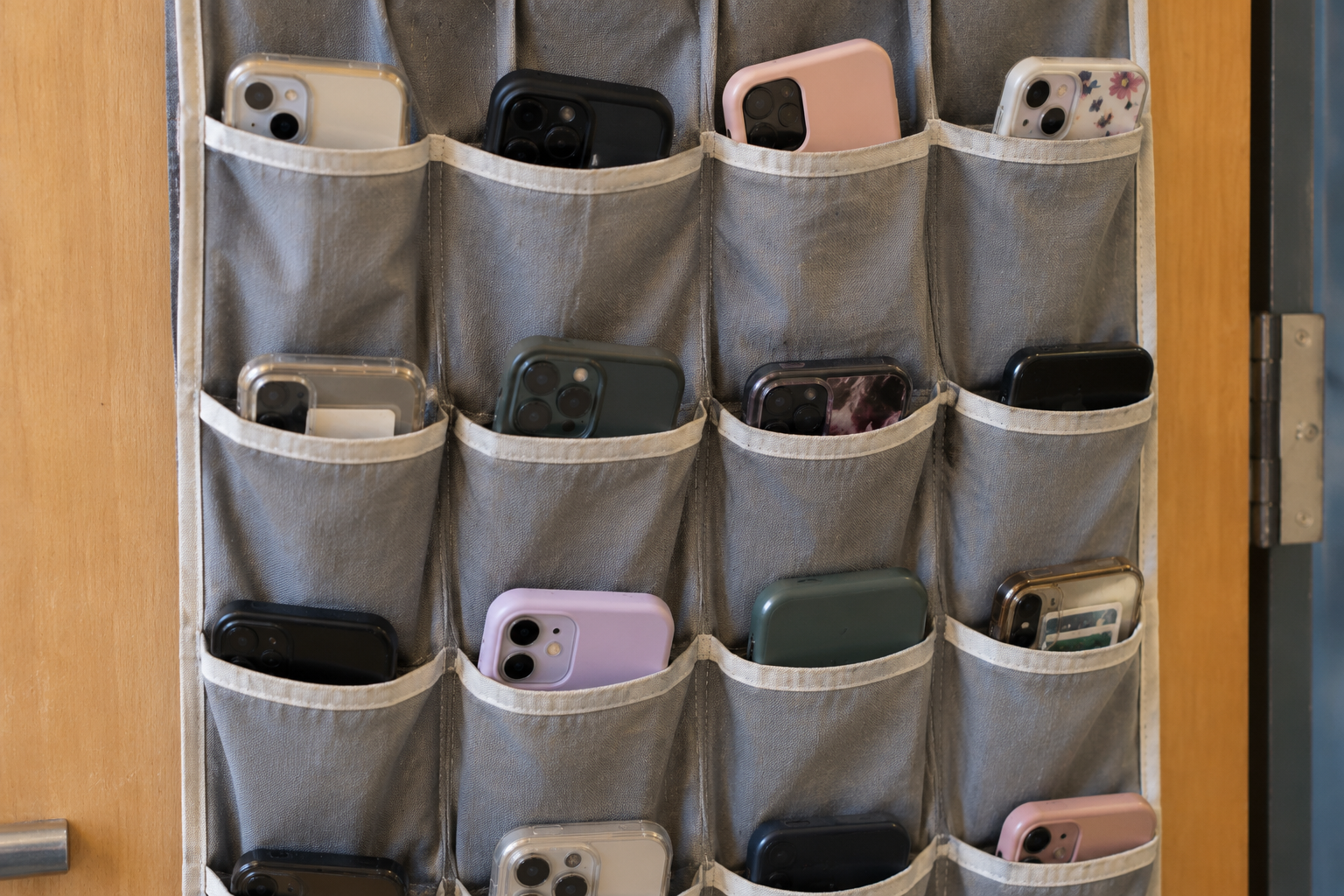
The law sets a default, not a single statewide mandate. School districts and charter schools can adopt a looser or different policy, and the law doesn't require any particular storage method. Some schools use lockers or cubbies, some use classroom phone caddies and some use lockable pouches.
What Are the Exceptions?
Even under the bell-to-bell default, students may use a phone:
- To respond to an imminent threat to someone's health or safety
- During a school-wide emergency
- To contact the SafeUT Crisis Line
- When the use is part of a student's IEP or Section 504 accommodation plan
- To address a medical necessity, such as a glucose monitor app
Schools can also allow purposeful classroom use. When the bill was ceremonially signed in April, Sen. Fillmore gave the example of an art teacher who wants students to use phone cameras to capture images they'll later turn into other media. The goal is to remove phones as a default distraction, not to ban every useful tool.
Why Did Utah Pass It?
The push came from teachers, parents and a growing number of students. National data helped make the case:
- A 2024 Pew Research Center survey found that about one in three U.S. teachers called student phone distraction a major problem. Among high school teachers, it was 72%.
- By 2025, Pew found that 74% of U.S. adults supported banning phones during class for middle and high school students, up from 68% the year before.
Supporters in Utah also pointed to schools that had already gone bell to bell, such as Granger High in West Valley City, which adopted its policy in 2024. Educators there reported more face-to-face connection between classes.
Does a Phone Ban Actually Improve Learning?
This is where honest answers matter. The largest study so far, a 2026 National Bureau of Economic Research working paper co-led by Stanford economist Thomas Dee, looked at about 4,600 schools that adopted lockable phone pouches. Here's what the researchers found:
| Outcome | What the study found |
|---|---|
| Phone use during school | Dropped significantly |
| Discipline incidents | Rose slightly in year one, then faded |
| Student well-being | Dipped in year one, turned positive by year two and rose above baseline within three years |
| Test scores (average) | Close to zero over the first three years |
| High school math | Modest positive effects |
| Middle school achievement | Small, generally negative effects |
| Attendance and chronic absenteeism | Effects close to zero |
The researchers offered a few possible explanations for the middle school results. Younger students may have less impulse control and swap phones for other distractions. Phone use also fell less in middle schools than in high schools, so those schools carried the costs of enforcement while seeing smaller benefits.
The takeaway isn't that phone limits don't work. It's that taking phones away is only half the job. The other half is giving students learning that holds their attention without a screen.
What Does This Mean for K–8 Families?
For younger elementary students, the law changes very little day to day. Most kindergarteners and early elementary kids don't carry phones to school, and many smartwatches marketed to kids include calling and messaging features. Ask your school how it treats watches and other connected devices.
For upper elementary and middle school students, the law matters more. Ages 10 to 14 are when many kids get their first phone, and those habits form fast. A few practical steps help:
- Know your school's policy. Read the family handbook or ask the front office where phones go during the day and how teachers handle exceptions.
- Set up a contact plan. Agree on how your child reaches you during the day, usually through the front office, and how you'll reach them.
- Talk about the why. Kids follow rules better when they understand them. Explain that the goal is focus and friendship, not punishment.
- Match it at home. Phone-free meals, phones charging outside bedrooms and a delayed first smartphone all reinforce what school is building.
- Watch the first few months. If your child seems more restless or anxious early on, that lines up with the research. Give it time, and talk with the teacher if it persists.
Why Engagement Matters More Than the Ban
A phone is the easiest escape from a boring lesson. Remove the phone without changing the lesson, and kids find another escape. That's one reason the research shows such different results from school to school.
Classrooms where kids are actively doing something tend to need fewer rules about distractions. When students are building, presenting, measuring, writing for a real audience or working on a project they chose, there's less pull toward a screen. We've written about this in The Hidden Cost of Boredom in School and Why Longer Learning Blocks Help Children Learn More.
How Does Ignite Fit In?
Ignite Entrepreneurship Academy is a tuition-free K–8 public charter school in Lehi, so Utah's school phone law applies here too. For specifics on how devices are handled at IEA, check the family handbook or contact the front office at (801) 901-8520.
What we can tell you is how Ignite approaches attention in the first place:
- Long, uninterrupted work periods. Montessori-style work cycles give students time to settle into deep focus instead of switching tasks every few minutes.
- Hands-on learning. Younger students work with concrete materials. Older students do project-based work with real deliverables.
- Entrepreneurship from K–8. Students design products, solve problems and pitch ideas, culminating in a middle school capstone.
- Movement and connection. Mixed-age classrooms, classroom jobs and Firebirds athletics for grades 6–8 give kids plenty of reasons to engage with each other in person.
To see how a day actually flows, read Inside an Ignite School Day.
Frequently Asked Questions
Does Utah ban cellphones in schools?
Yes, by default. Under SB 69, Utah public schools restrict student cellphone use from the opening bell to the closing bell, starting with the 2026–2027 school year. Schools and districts can modify the default policy.
When did Utah's bell-to-bell phone law take effect?
SB 69 was signed March 19, 2026, and took effect July 1, 2026.
Does the phone law apply to charter schools?
Yes. Utah charter schools are public schools, and the law's default applies to both school districts and charter schools. Each can adopt a different policy through its governing board.
What are the exceptions to Utah's school phone ban?
Students may use phones to respond to a health or safety threat, during a school-wide emergency, to contact the SafeUT Crisis Line, as part of an IEP or 504 plan, or for a medical necessity. Teachers may also allow phones for specific classroom activities.
Can my child still bring a phone to school?
Generally, yes. The law restricts use during the school day, not possession on the way to and from school. Each school decides where phones are stored during the day.
Do smartwatches count?
Policies on smartwatches and other connected devices vary by school. Ask your school directly, especially if your child's watch can call or text.
Do phone bans improve test scores?
Not on their own, at least not yet. A 2026 national study of about 4,600 schools found average test score effects near zero in the first three years, with modest gains in high school math and small negative effects in middle school. Student well-being improved over time.
The Bottom Line
Utah's bell-to-bell law gives every public school, including Ignite, a clear default: the school day belongs to learning and to the people in the room. The early research says the ban alone won't transform outcomes. What students do with the attention they get back is what counts.
If you're looking for a school where kids are engaged enough that the phone isn't the main competition, come see Ignite in person. Take the virtual tour, bring these 10 tour questions, and mark November 16 on your calendar. That's when applications open for the 2027–2028 lottery.
Ready to join IEA?
Give your child a Montessori foundation and entrepreneurial wings. Apply to the Ignite Entrepreneurship Academy enrollment lottery today.
Apply to the lottery