Why Classroom Jobs Matter at IEA: How Small Responsibilities Build Big Skills
At first glance, a classroom job can look small.
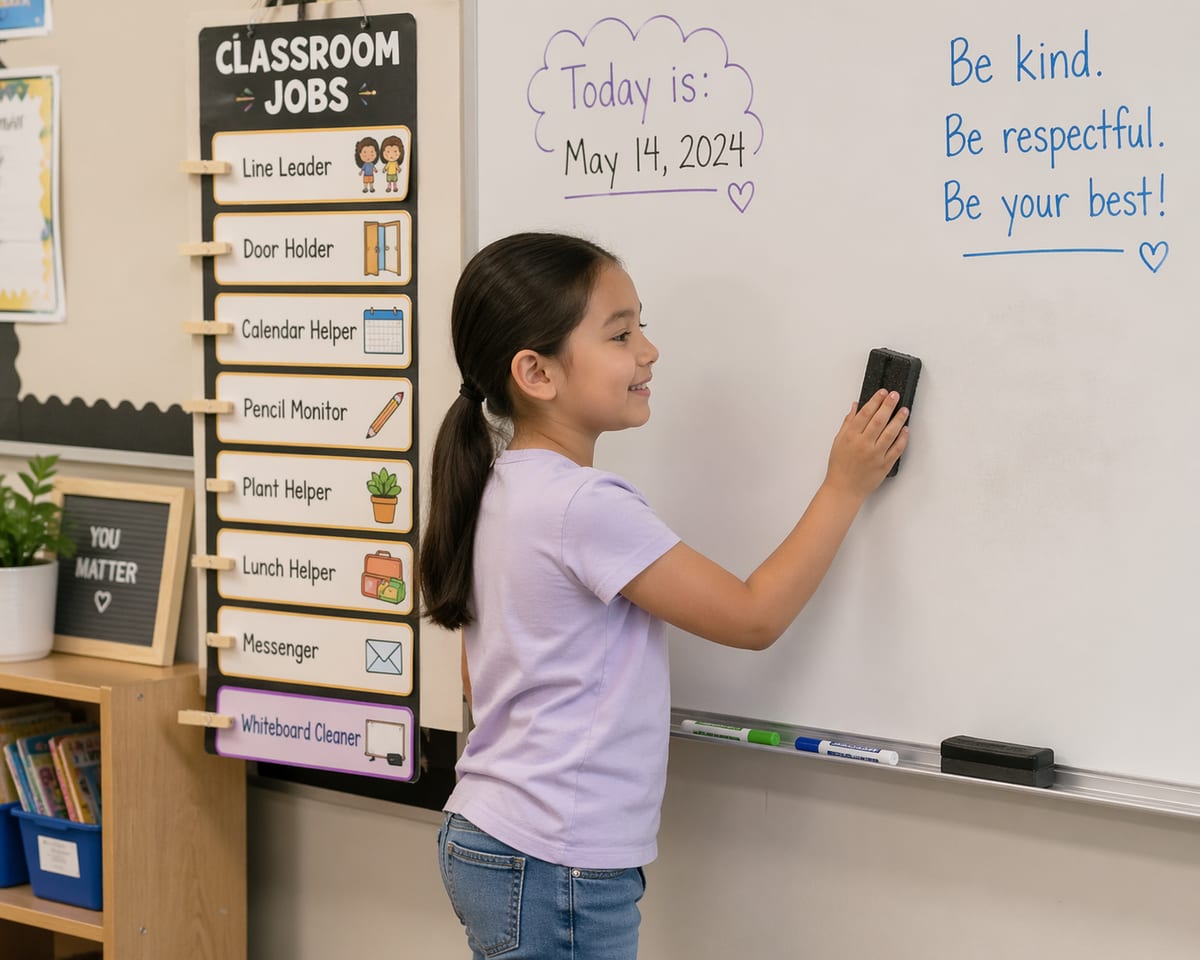
A student waters the plant. Someone straightens the books. Another student passes out materials, wipes a table, checks supplies, or helps a younger classmate find what they need.
It can seem like a simple classroom routine.
But at Ignite Entrepreneurship Academy, classroom jobs are more than a way to keep the room tidy.
They are one of the small, everyday ways students learn responsibility, ownership, service, and leadership.
That matters because children do not become responsible by hearing adults talk about responsibility. They become responsible by practicing it. They need real chances to be trusted, to follow through, to notice what a community needs, and to see that their contribution makes a difference.
Classroom jobs give students that chance.
Classroom Jobs Make Responsibility Real
Most children have heard the word “responsibility” many times.
Be responsible. Act responsible. Take responsibility.
But for a young child, responsibility can feel like an adult word until it becomes connected to a real task.
When a student is the plant caretaker, the job is concrete. If they remember to water the plant, the plant does better. If they forget, the plant starts to droop. That is not a lecture. That is a lesson.
The same thing happens when a student is in charge of organizing materials, checking the classroom library, cleaning up a shared space, or helping prepare for the next activity. Their actions affect the group.
That is powerful.
Children start to understand:
- My work matters.
- People are counting on me.
- I can help the classroom run better.
- I am part of something bigger than myself.
That is the kind of responsibility that sticks.
Classroom Jobs Fit IEA’s Montessori Roots
IEA’s model is built on “Montessori Roots, Entrepreneurial Wings,” combining Montessori principles with modern entrepreneurial skills and mindsets (Ignite Mission & Vision).
Classroom jobs fit naturally into that foundation.
In Montessori education, everyday practical work is not treated as a distraction from learning. It is part of learning. Practical life activities help children build independence, concentration, coordination, and social responsibility. The American Montessori Society describes practical life at older levels as supporting students’ social independence, executive functioning, leadership, and ability to contribute meaningfully to a community (American Montessori Society).
That is exactly why classroom jobs matter.
When a child helps maintain the learning environment, they are not just doing a chore. They are practicing independence. They are learning how to care for a shared space. They are building the habit of seeing what needs to be done and doing their part.
That habit supports academics too.
A student who learns to organize supplies, complete a weekly classroom role, check their work area, and follow through on a task is also practicing the same executive functioning skills they need for reading, writing, projects, and group work.
Classroom Jobs Build Ownership
A classroom feels different when students help take care of it.
It stops feeling like a room that belongs only to the teacher.
It becomes our room.
That shift is important. IEA’s mission says the school fosters self-directed learners who take ownership of their education, make thoughtful decisions, and develop confidence to pursue their goals (Ignite Mission & Vision).
Classroom jobs are one of the earliest ways students practice that kind of ownership.
They do not just wait for an adult to fix everything. They learn to notice:
- The pencils need sharpening.
- The shelf is messy.
- A classmate needs help.
- The materials are not ready.
- The floor needs to be picked up.
- The next group will need this space.
That may sound simple, but it is not small.
The child who learns to notice and act is developing the same mindset that later supports project-based learning, entrepreneurship, leadership, and service.
Entrepreneurs notice needs. Good teammates notice needs. Community members notice needs.
Classroom jobs are one way students begin practicing that.

Classroom Jobs Support Student Agency
Student agency means students see themselves as active participants in their learning and community, not passive recipients of adult directions.
That does not mean students run the classroom. It means adults intentionally build students’ capacity to make choices, contribute, and take responsibility. ASCD notes that student agency requires adults to build students’ knowledge and skills so they can participate meaningfully rather than being handed freedom without support (ASCD).
Classroom jobs are a very practical version of that.
Students are given a role. They learn what the role requires. They practice. They get reminders. They improve. Over time, they need fewer reminders.
That is agency in a form children can understand.
They are not just being told, “Take ownership.” They are being given something real to own.
Classroom Jobs Help Build Community
A healthy classroom is not just a place where one teacher manages twenty or thirty students.
It is a small community.
In a strong community, people contribute. They notice each other. They take care of shared spaces. They understand that their choices affect the group.
Classroom jobs help students experience that in a concrete way.
A line leader helps the class move safely. A materials manager helps the next activity start smoothly. A cleanup crew makes the room better for everyone. A classroom greeter helps visitors or new students feel welcome.
These jobs teach students that leadership is not always loud.
Sometimes leadership looks like being reliable.
Sometimes it looks like doing a small task without applause.
Sometimes it looks like helping the person next to you.
That kind of community-building connects closely with social and emotional learning. CASEL identifies responsible decision-making, relationship skills, social awareness, self-management, and self-awareness as core social and emotional competencies (CASEL).
Classroom jobs touch many of those skills at once.
Students practice self-management when they remember their job. They practice social awareness when they notice what the group needs. They practice relationship skills when they help others. They practice responsible decision-making when they choose to follow through even when they would rather do something else.
Classroom Jobs Build Confidence
Confidence does not always come from praise.
Often, confidence comes from competence.
A student feels capable because they have done something useful. They know how to set up the room. They know how to help a younger student. They know how to prepare materials. They know how to solve a small problem without waiting for an adult.
That feeling matters.
Some students shine during academic work. Others first shine when they are trusted with a responsibility. A child who struggles with reading may be an incredible helper. A quiet student may become dependable in a classroom job. A high-energy student may become focused when they have a real role.
Classroom jobs give students more ways to be seen.
They also help children experience success in a way that is not only tied to grades, tests, or being the fastest to finish.
That is good for a classroom.
It is good for a child too.
Classroom Jobs Are Early Entrepreneurship Practice
At IEA, entrepreneurship is not only about starting businesses.
IEA’s mission describes entrepreneurial education as helping students innovate, lead, create value, understand needs, solve problems, communicate, work as a team, and participate in student-run businesses and community partnerships (Ignite Mission & Vision).
Classroom jobs are an early version of that same mindset.
A student with a classroom job learns to ask:
- What needs to be done?
- Who does this help?
- How can I make this work better?
- What happens if I do not follow through?
- How can I improve the system?
That is value creation at a child’s level.
Maybe a student notices that the pencil cup is always empty by math time and suggests a better refill system. Maybe the classroom librarian realizes books are getting returned to the wrong bins and creates clearer labels. Maybe a cleanup captain notices transitions are taking too long and helps create a faster routine.
Those are not pretend skills.
They are the beginning of problem-solving, leadership, and service.
Examples of Classroom Jobs and the Skills They Build
Classroom jobs can look different depending on the age of the students, the classroom, and the teacher’s routines.
Here are a few examples of jobs and the skills they can build.
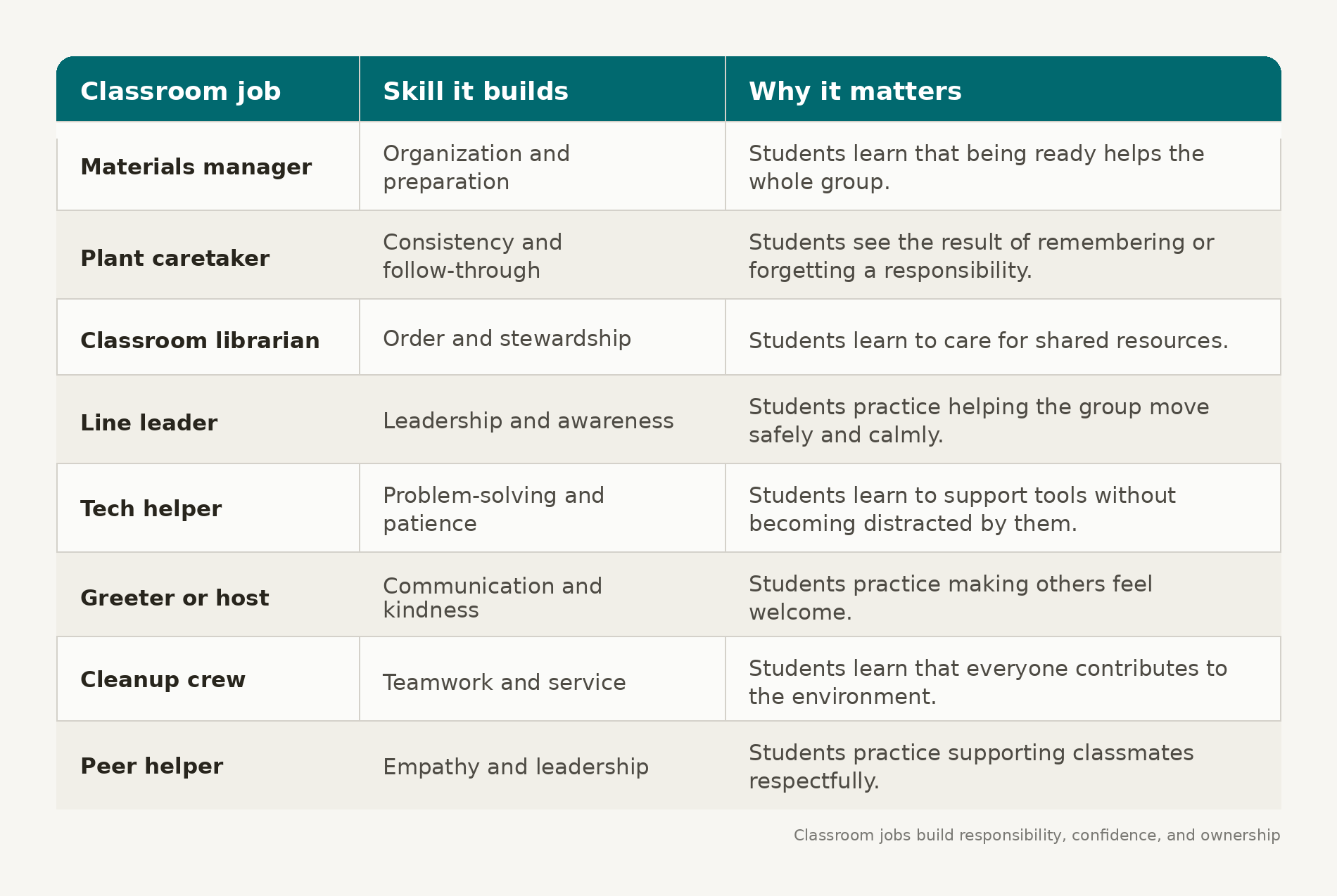
The job itself is not the whole lesson.
The lesson is what the child practices while doing the job.
Why Small Jobs Matter Later
It is easy to underestimate small routines.
But childhood is built out of repeated experiences.
A child who repeatedly hears, “You are capable,” and then gets real chances to act capable begins to believe it.
A child who repeatedly contributes to a classroom begins to see themselves as someone who contributes.
A child who repeatedly follows through on small responsibilities is more prepared for bigger responsibilities later.
That is how classroom jobs connect to the bigger picture at IEA.
They support the same traits families want their children to develop over time:
- Responsibility
- Confidence
- Independence
- Service
- Leadership
- Collaboration
- Problem-solving
- Ownership
Those traits do not suddenly appear in middle school, high school, or adulthood.
They are practiced in small ways first.
How Parents Can Reinforce This at Home
Parents can support the same habit at home without making it complicated.
Give your child a real job that matters to the family.
Not busywork. Not something you secretly redo every time. A real contribution.
For younger children, that might be:
- Feeding a pet
- Matching socks
- Setting napkins on the table
- Watering a plant
- Putting shoes in a basket
For older children, it might be:
- Packing part of their lunch
- Helping plan a simple meal
- Taking out recycling
- Managing their backpack checklist
- Organizing a shared space
- Helping a younger sibling with a routine
The key is to connect the job to purpose.
Instead of saying, “Do your chore,” try saying:
“This helps our family get ready faster.”
“This keeps our home working well.”
“This is your way to contribute.”
Children are more likely to take responsibility seriously when they understand why it matters.
Final Thought
Classroom jobs may look small from the outside.
But inside a child, they can do big work.
They teach students that they are capable. They show students that their actions matter. They help students care for their environment, support their classmates, and practice leadership in everyday ways.
At IEA, that fits the bigger mission.
Students are not only learning facts. They are learning how to be thoughtful, capable, creative, responsible people who can contribute to a community.
Sometimes that starts with a business idea.
Sometimes it starts with a project.
And sometimes it starts with watering the plant.
FAQ
What are classroom jobs?
Classroom jobs are student responsibilities that help a classroom run smoothly. They might include organizing materials, caring for plants, helping with cleanup, leading a line, greeting visitors, managing supplies, or helping classmates.
Why does IEA use classroom jobs?
IEA uses classroom jobs because they help students practice responsibility, independence, service, leadership, and ownership in everyday ways. These habits connect with IEA’s Montessori roots and entrepreneurial focus.
Are classroom jobs just chores?
No. Classroom jobs are not just chores. When done intentionally, they help students learn to contribute to a community, follow through on responsibilities, solve small problems, and see themselves as capable.
How do classroom jobs connect to Montessori?
Montessori education values practical life, independence, purposeful work, and care for the environment. Classroom jobs give students real opportunities to practice those habits in a shared learning space.
How do classroom jobs connect to entrepreneurship?
Entrepreneurship starts with noticing needs and creating value. Classroom jobs help students practice noticing what the classroom needs, taking action, improving systems, and helping others.
Can parents use classroom jobs at home?
Yes. Parents can give children age-appropriate responsibilities at home, such as setting the table, feeding a pet, organizing shoes, watering plants, packing lunch items, or helping with a shared family routine.
Ready to join IEA?
Give your child a Montessori foundation and entrepreneurial wings. Apply to the Ignite Entrepreneurship Academy enrollment lottery today.
Apply to the lottery