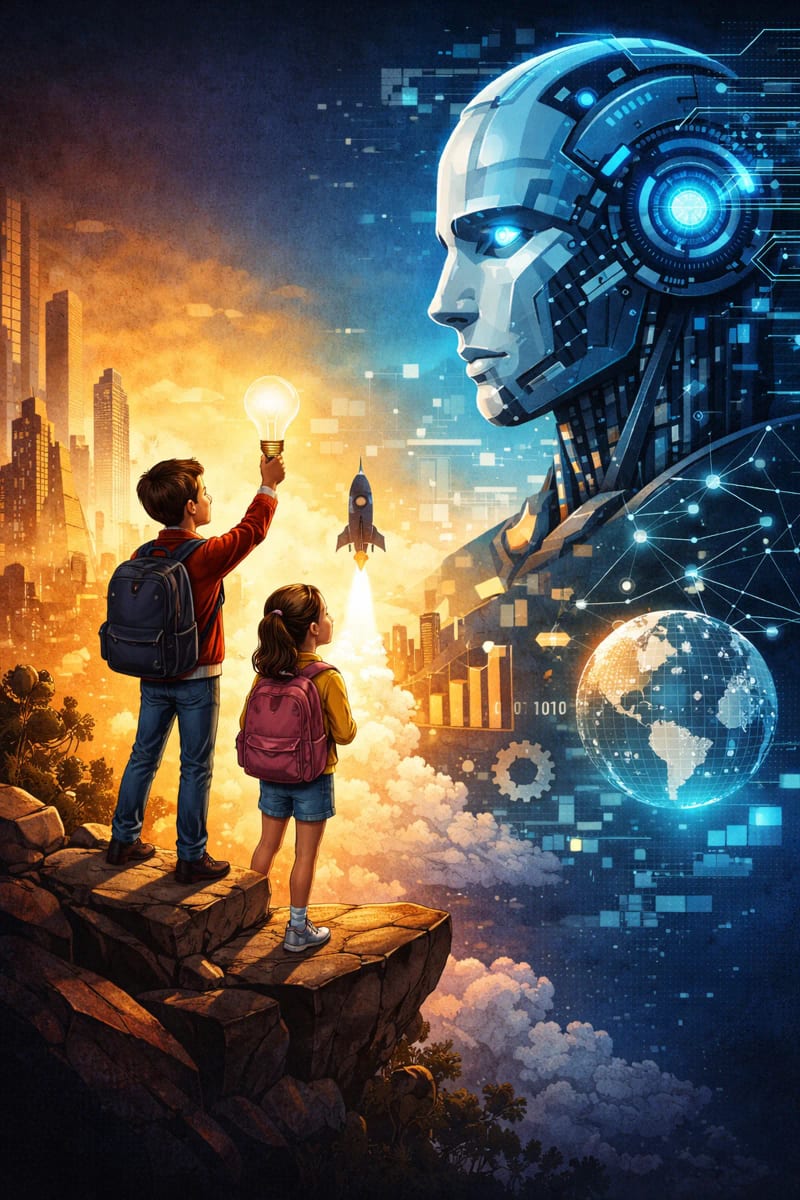
Why Entrepreneurial Thinking Matters More Than Ever in the Age of AI
Artificial intelligence is no longer a future concept—it’s already shaping how we work, communicate, and solve problems. Tools that once required years of training can now perform tasks instantly. For parents, this raises an important question: what should children actually be learning today to be prepared for tomorrow?
The answer isn’t more information. It’s better thinking.
The Problem With Teaching Kids for a World That No Longer Exists
For decades, education has prioritized efficiency: mastering procedures, following instructions, producing correct answers. That made sense in a world where knowledge was scarce and information had to be memorized.
AI has changed that reality. Information is now abundant. Instructions can be generated instantly. What matters most is not whether a student can recall facts, but whether they can evaluate them, apply them, and decide what to do next.
As education researcher Tony Wagner, former Harvard Innovation Lab expert, put it:
“The world doesn’t care what you know. It cares what you can do with what you know.”
When learning is centered only on compliance and correctness, students become dependent on directions. In a world shaped by AI, dependence is a disadvantage.
What AI Can Replace—and What It Can’t
AI excels at speed, repetition, and pattern recognition. It can summarize text, generate content, and automate repetitive tasks. But it cannot:
• Decide which problems matter
• Apply judgment in complex human situations
• Take responsibility for outcomes
• Learn from failure with wisdom and context
Those skills require something AI doesn’t have: human agency.
Microsoft CEO Satya Nadella has emphasized this shift clearly:
“The real competitive advantage in the age of AI will be human judgment—knowing what questions to ask and how to apply the answers.”
Entrepreneurial thinking develops exactly that kind of judgment.
Entrepreneurial Thinking Is Not About Business
One of the biggest misconceptions about entrepreneurship in education is that it’s about money or startups. In reality, entrepreneurial thinking is about agency.
It teaches children to see themselves as capable of:
• Noticing problems instead of ignoring them
• Generating ideas instead of waiting for answers
• Testing solutions instead of fearing mistakes
• Owning outcomes instead of blaming systems
This mindset prepares students to use AI as a tool—not rely on it as a substitute for thinking.
Why This Mindset Must Start in Elementary School
By the time students reach adolescence, many have already learned to play it safe. They look for rubrics, ask what the teacher wants, and avoid risk. That pattern doesn’t come from laziness—it comes from years of being rewarded for compliance over curiosity.
Elementary school is the window where this can change.
At this age, children are still willing to experiment, revise, and imagine. When entrepreneurial thinking is introduced early, students learn that effort matters, ideas evolve, and learning is something they actively participate in—not something that happens to them.
What Entrepreneurial Learning Looks Like in Practice
In classrooms that prioritize entrepreneurial thinking, learning looks different:
• Students work on open-ended problems without one “right” answer
• Reflection matters as much as results
• Mistakes are treated as information, not failure
• Students explain their thinking, not just their conclusions
This type of learning builds confidence because students see that their ideas have value—and that improvement comes through iteration, not perfection.
Preparing Kids for an Unknown Future
No one knows exactly what the workforce will look like in twenty years. But one thing is clear: the most successful adults will be those who can adapt, learn independently, and think critically in unfamiliar situations.
Entrepreneurial thinking prepares children for that uncertainty. It helps them develop resilience, judgment, and initiative—skills that remain valuable no matter how technology evolves.
Teaching this way isn’t about predicting the future. It’s about giving children the capacity to navigate it.
The Role of Schools Moving Forward
In an AI-driven world, schools have a choice. They can double down on control and standardization, or they can help students become thoughtful, capable problem-solvers.
Entrepreneurial education offers a path forward—one that respects children’s ability to think, create, and contribute meaningfully. When students learn how to take ownership of their learning, they don’t just keep up with change. They’re prepared to lead through it.
How Ignite is preparing students for an AI future
This philosophy is embedded in the way students learn at Ignite Entrepreneurship Academy. Through project-based learning, student choice, and real-world problem solving, students are regularly asked to think critically, reflect on their work, and take ownership of outcomes. Rather than relying on step-by-step instructions or predetermined answers, students practice identifying problems, testing ideas, and learning through iteration. Technology—including AI tools—is treated as a support, not a shortcut. The focus remains on developing judgment, adaptability, and confidence—skills that prepare students not just for the next grade level, but for a future where independent thinking matters more than ever.
Ready to join IEA?
Give your child a Montessori foundation and entrepreneurial wings. Apply to the Ignite Entrepreneurship Academy enrollment lottery today.
Apply to the lottery