How to Know If a Charter School Is the Right Fit for Your Child: A Utah Parent Checklist
Choosing a school can feel a little like buying a house.
At first, every option sounds good in the brochure. Strong teachers. Great community. Innovative learning. Small-school feel. Future-ready skills.
But once you walk through the doors, the real question is much more personal:
Can I picture my child thriving here?
That question matters because charter schools are not all built the same way. In Utah, charter schools are tuition-free public schools open to any Utah student, but they can offer families different choices in where students attend and the school’s curricular emphasis, according to the Utah State Board of Education. That means one charter school might focus on STEM, another on classical education, another on language immersion, and another, like Ignite Entrepreneurship Academy, on Montessori roots, project-based learning, blended learning, and entrepreneurship.
So instead of asking, “Is this a good school?” it may be more useful to ask:
Is this a good school for my child?
This checklist can help Utah County families think through that decision.
First, Know What “Fit” Actually Means
School fit is not about finding a perfect school. No school is perfect.
Fit means the school’s learning model, expectations, culture, communication style, and daily environment match what your child needs in order to grow.
For one child, that might mean a quiet, highly structured classroom. For another, it might mean hands-on projects, movement, leadership opportunities, and space to ask big questions. One child may love a traditional worksheet-and-test rhythm. Another may come alive when they can build, present, collaborate, and connect learning to real life.
Parents usually know more than they think they do. You have seen your child at the kitchen table, in group projects, at sports practice, during a meltdown, and in the moments when they suddenly become fascinated by something. Those observations are useful.
If your child spends Saturday building a cardboard vending machine, organizing a neighborhood bake sale, taking apart old electronics, making videos, designing games, or asking how businesses make money, that is information. It may tell you something about the kind of environment where they will feel challenged instead of boxed in.
Start With Your Child, Not the School’s Marketing
Before comparing schools, write down what you already know about your child.
Use questions like these:
- Does my child like clear routines, flexible choices, or a mix of both?
- Do they work well independently, or do they need frequent adult direction?
- Are they energized by group work, or drained by it?
- Do they like hands-on learning?
- Do they ask “why” and “how” questions?
- Do they recover well from mistakes, or do they shut down quickly?
- Do they enjoy presenting, building, creating, leading, or solving real-world problems?
- Are they ready for more ownership, or do they still need a lot of structure?
This is where many parents get stuck. They compare test scores, buildings, social media posts, and waitlists before they compare the school to the actual child who will be attending.
Scores and logistics matter. But a strong school fit usually starts with a simple match: the way the school teaches should make sense for the way your child learns.
Understand the School’s Learning Model
Every charter school should be able to explain its learning model in plain English.
If a school says it uses project-based learning, ask what that looks like during a normal week. If it says it is Montessori-inspired, ask how much student choice exists and how teachers guide progress. If it says it builds leadership, ask where students actually practice leadership.
At Ignite, the model is built around Montessori principles, blended learning, project-based experiences, and entrepreneurship. The school describes its approach as “Montessori Roots, Entrepreneurial Wings,” with a traditional Montessori model in the early grades and a blended learning model in upper grades (Ignite Entrepreneurship Academy). Its mission page also describes a focus on self-directed learners, innovative thinking, problem-solving, design thinking, student-run businesses, and community partnerships (Ignite Mission & Vision).
That model can be powerful for the right student. It may be especially appealing for children who like to create, explore, collaborate, move from idea to action, and understand why their learning matters.
It may feel less comfortable at first for a child who is used to being told exactly what to do at every step. That does not mean the model is wrong for them. It means parents should ask how the school supports students as they grow into more independence.
For more background on this model, Ignite has a helpful parent guide on what project-based learning is and how it works.
Look for Belonging, Not Just Achievement
When parents tour schools, it is natural to look at academics first.
What curriculum do they use? How are test scores? What math level will my child be in? How much homework is there?
Those questions matter. But do not miss the quieter question:
Will my child feel known here?
Research has repeatedly linked school belonging with stronger academic outcomes. One longitudinal study of fifth-grade students found that school belonging predicted greater academic competence and academic expectations over time (Journal of Research on Adolescence).
That does not mean a school should feel easy all the time. In fact, the right school should stretch a child. But students are more willing to take academic risks when they feel safe, seen, and supported.
On a tour or open house, watch for small clues:
- Do adults greet students by name?
- Do students seem comfortable asking questions?
- Is student work visible?
- Can students explain what they are learning?
- Do teachers talk about students as individuals, not just grade levels?
- Does the school have a clear way to help students who are struggling socially or academically?
Sometimes the best tour moment is not the polished presentation. It is the five seconds when you see how a teacher redirects a student, how students move through the hallway, or whether kids seem proud of their work.
Ask Whether the School Builds Independence Gradually
Many parents want their children to become independent learners. Fewer parents want their children thrown into independence without support.
The difference matters.
A good fit school does not simply say, “Students take ownership.” It shows how students are taught to take ownership.
Look for systems like:
- Clear goals
- Regular teacher check-ins
- Progress tracking
- Reflection routines
- Student conferences
- Opportunities to revise work
- Age-appropriate choice
- Parent communication when a child is stuck
This is especially important in project-based or Montessori-inspired environments. The goal is not chaos. The goal is freedom within structure.
That phrase matters because children do not become self-directed overnight. They learn it through repeated practice: choosing a task, managing time, asking for help, receiving feedback, trying again, and seeing the result of their effort.
If your child is creative but scattered, ask how the school helps students plan. If your child is bright but anxious, ask how teachers break big projects into smaller steps. If your child loves to lead, ask how leadership is coached so it becomes service, not bossiness.
Compare the Daily Experience
A school’s philosophy matters, but your child will live the daily routine.
Ask what a normal day actually looks like.
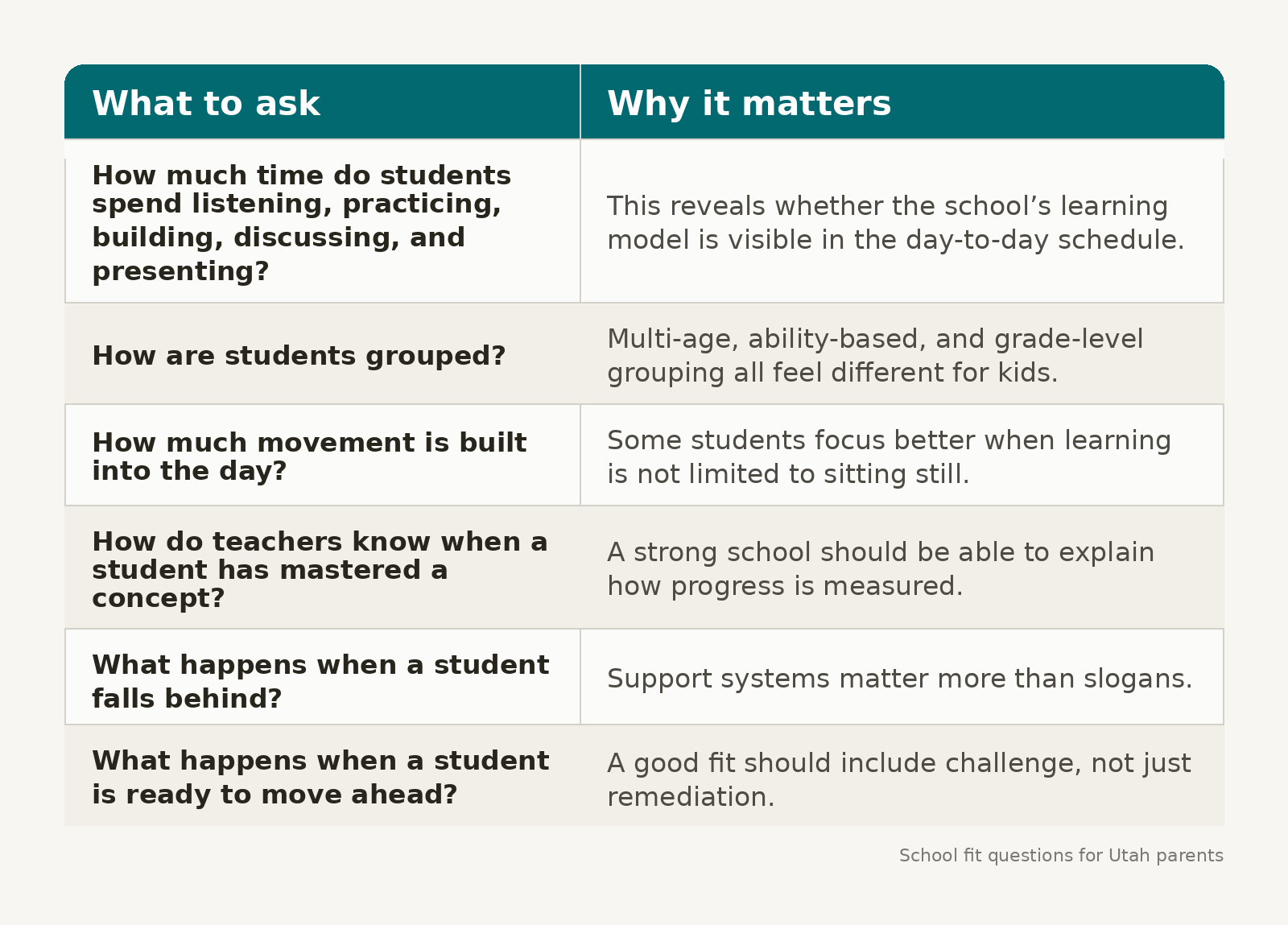
Pay Attention to the Kind of Work Students Produce
If student work is on display, slow down and look at it.
Is it all identical? Or can you see student thinking?
There is nothing wrong with neat, teacher-guided assignments. But if a school says it values creativity, problem-solving, or project-based learning, you should see work that shows decisions students made.
For example, in a strong project-based classroom, you might see:
- A prototype students tested and improved
- A business pitch with pricing and customer feedback
- A science model with written explanations
- A group presentation with research notes
- A reflection about what did not work the first time
- A class market, museum, debate, or exhibition
That kind of work can build academic skills and confidence at the same time. A 2023 meta-analysis of 66 studies found that project-based learning had a positive effect on student learning outcomes, including academic achievement, thinking skills, and affective attitudes (Frontiers in Psychology).
The phrase “when implemented well” is important. Projects should not be random crafts. They should have structure, academic purpose, feedback, and reflection.
Ignite’s own parent guide makes a similar point: real project-based learning includes meaningful questions, student voice, inquiry, collaboration, a final product, and reflection (What Is Project-Based Learning?).
Decide How Much Structure Your Child Needs
This is one of the most honest questions a parent can ask.
Some children thrive when they have more freedom. Others need a predictable routine before they can take creative risks. Many need both.
The right question is not, “Is this school strict or flexible?”
The better question is:
How does this school balance structure and independence?
For example:
- A child who loves choice may still need deadlines.
- A child who is shy may still benefit from presentations, if they are coached gently.
- A child who is easily bored may need deeper projects, not just extra worksheets.
- A child who struggles with organization may do well in a self-directed model if the school teaches planning explicitly.
- A child who has always been compliant may need practice developing their own ideas.
A good school fit does not mean your child will never be uncomfortable. Growth is often uncomfortable. But the discomfort should be productive, supported, and connected to a clear purpose.
Consider the Middle School Years Separately
Middle school deserves its own conversation.
The jump from elementary school to adolescence changes what students need. They are forming identity, testing independence, caring more about peers, and starting to imagine who they might become.
Ignite describes its middle school program for 7th and 8th grade as a blend of structured mentoring, project-based learning, skill building, service learning, career exploration, financial literacy simulation, leadership, and pop-up business experiences (Ignite Middle School Program).
That combination can be especially valuable for students who are ready to connect school to real life.
For example, a middle school student who creates a small pop-up business is not just “doing entrepreneurship.” They may be practicing math through pricing, writing through marketing, communication through selling, social studies through understanding community needs, and reflection through evaluating what worked.
That is the kind of experience many students remember because it feels real.
If you are choosing a school for 7th or 8th grade, ask:
- How does the school help students prepare for high school?
- What leadership opportunities exist?
- How are students mentored?
- How are executive function skills taught?
- Do students get chances to explore careers, money, service, and real-world problem-solving?
- Will my child be known by adults during these years?
For more context, Ignite also has a post on how entrepreneurship can help 7th and 8th graders build confidence.
Use This Charter School Fit Checklist
As you compare Utah County schools, use this checklist as a practical filter.
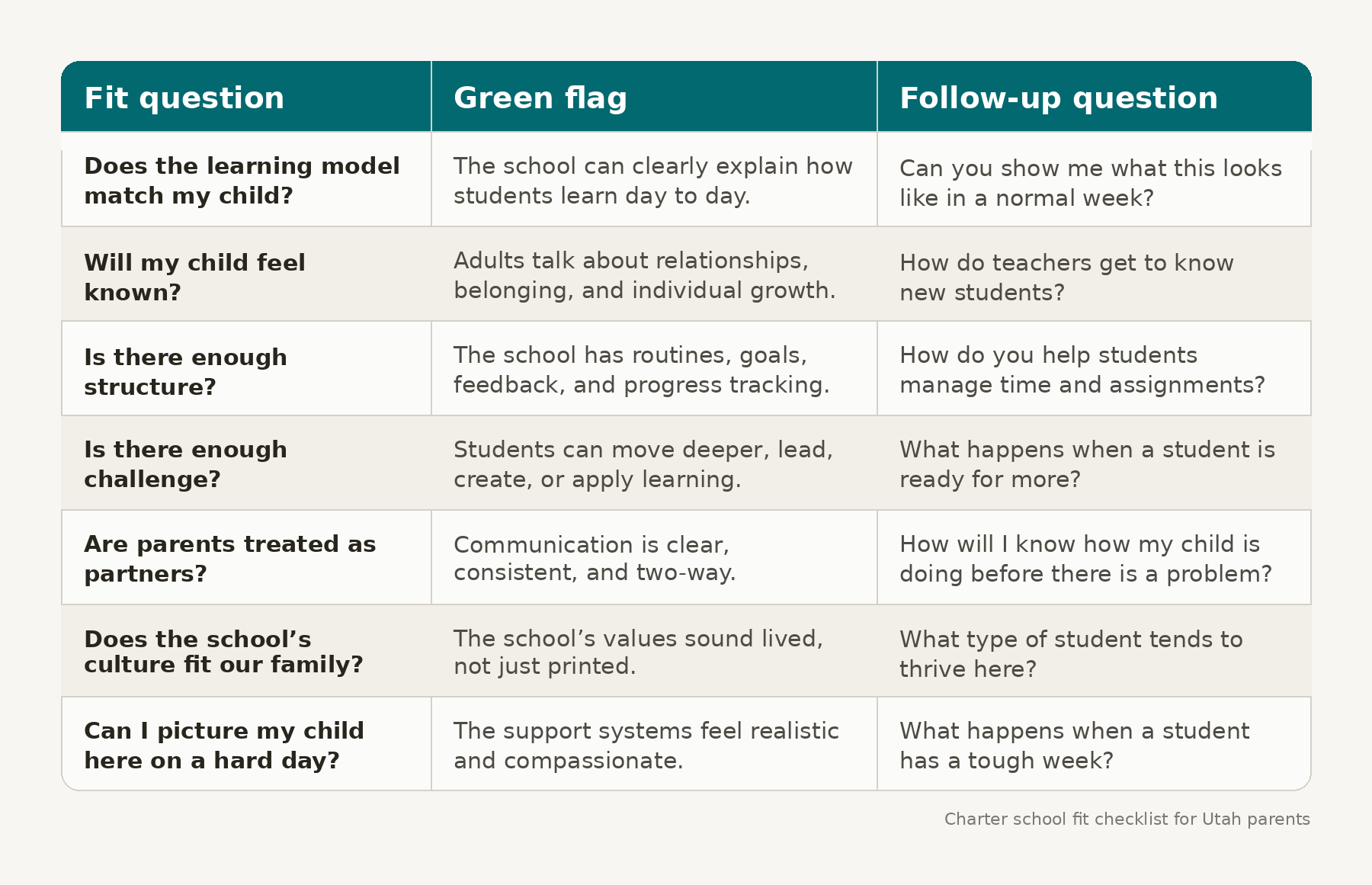
That last question may be the most important one.
It is easy to picture your child thriving on the best day. Try to picture them on a hard day. Tired. Frustrated. Behind on a project. Nervous about presenting. Unsure how to handle a friendship issue.
Would this school know what to do?
Would your child know who to go to?
Would the adults respond in a way that builds responsibility and confidence?
That is fit.
A Quick Note About Enrollment
Because Utah charter schools are public schools, they do not simply choose students based on grades, behavior, or ability. When there are more applicants than seats, charter schools generally use a lottery process.
If Ignite feels like a possible fit, the next step is to review the current Ignite lottery and waitlist information. Families can also read Ignite’s guide to how Utah’s charter school lottery works.
Even if you are not ready to apply today, it is worth learning the timeline early. School choice is much less stressful when you are not trying to decode deadlines at the last minute.
Final Thought
The right school is not always the one with the flashiest program or the longest waitlist.
It is the one where your child can be challenged, supported, known, and invited to grow into more of who they are capable of becoming.
For some students, that may be a traditional neighborhood school. For others, it may be a STEM academy, a private school, homeschool, or a different charter model.
And for some children, especially those who are curious, creative, hands-on, independent, entrepreneurial, or ready to build confidence through real-world learning, a school like Ignite may be the right fit.
The best way to know is to look past the brochure, ask specific questions, and pay attention to your child.
They are the reason the decision matters.
FAQ
Are charter schools free in Utah?
Yes. Utah charter schools are tuition-free public schools open to any Utah student, according to the Utah State Board of Education.
Do Utah charter schools choose which students they admit?
Charter schools are public schools, so they are open to students and do not admit based on academic ability. When applications exceed available seats, schools typically use a lottery process. Ignite explains its current application options on the lottery page.
What type of child does well in a project-based charter school?
Project-based learning can be a strong fit for students who like hands-on work, real-world questions, collaboration, creativity, and applying what they learn. It can also help students build confidence and problem-solving skills when projects are structured well.
What should I ask when touring a charter school?
Ask what a normal day looks like, how progress is measured, how teachers support struggling students, how advanced students are challenged, how parents are kept informed, and what type of student tends to thrive there.
Is Ignite Entrepreneurship Academy a Montessori school?
Ignite describes its model as “Montessori Roots, Entrepreneurial Wings.” The school uses a traditional Montessori model in the early grades and blends Montessori principles with project-based learning, blended learning, and entrepreneurship in later grades (Ignite Entrepreneurship Academy).
How do I know if Ignite is the right fit for my child?
Ignite may be a strong fit if your child is curious, creative, hands-on, increasingly independent, interested in real-world projects, or ready to build confidence through ownership and problem-solving. The best next step is to compare your child’s needs with Ignite’s mission, program pages, and enrollment process.
Ready to join IEA?
Give your child a Montessori foundation and entrepreneurial wings. Apply to the Ignite Entrepreneurship Academy enrollment lottery today.
Apply to the lottery