Tuition-Free Montessori in Utah: How Public Montessori Charter Schools Work
Most parents hear the word “Montessori” and immediately think of private school tuition.
That makes sense. In many communities, Montessori is something families associate with preschool programs, private elementary schools, waitlists, and monthly payments that can feel out of reach.
But in Utah, Montessori does not always mean private school.
Some public charter schools use Montessori principles while remaining tuition-free public schools. That can surprise parents who like the idea of hands-on learning, independence, and calmer classrooms but assume Montessori is not financially realistic for their family.
So let’s answer the big question first.
Yes, Montessori can be tuition-free in Utah when it is offered through a public charter school.
The Utah State Board of Education explains that charter schools are tuition-free public schools open to any Utah student. Charter schools are still public schools, but they can offer families additional choices in a school’s curricular emphasis, which is why some charter schools focus on STEM, classical education, language immersion, Waldorf-inspired learning, or Montessori-inspired learning.
At Ignite Entrepreneurship Academy, that model looks like “Montessori Roots, Entrepreneurial Wings.” Ignite combines Montessori principles with project-based learning, blended learning, and entrepreneurship in a tuition-free public charter school setting.
What “Tuition-Free Montessori” Actually Means
Tuition-free Montessori does not mean a private Montessori school decided to stop charging tuition.
It usually means a public charter school has built its educational model around Montessori or Montessori-inspired principles.
In practical terms, that means families get access to a public school option that may include many of the things parents like about Montessori:
- Hands-on learning
- Student independence
- Movement during the day
- Multi-age learning when appropriate
- Teachers who guide instead of only lecture
- Purposeful classroom routines
- Less reliance on worksheets
- A focus on responsibility, confidence, and curiosity
But because the school is public, it is funded differently than a private Montessori school. Families do not pay tuition to attend.
That distinction matters.
A private Montessori school and a public Montessori charter school may share similar values, but they are not the same type of school. They may differ in admissions, funding, state requirements, teacher roles, assessment, curriculum structure, and how fully they implement the Montessori method.
If you are comparing options, it helps to understand the categories.
Private Montessori vs. Public Montessori Charter vs. Traditional Public School
Here is the simplest way to think about the difference.
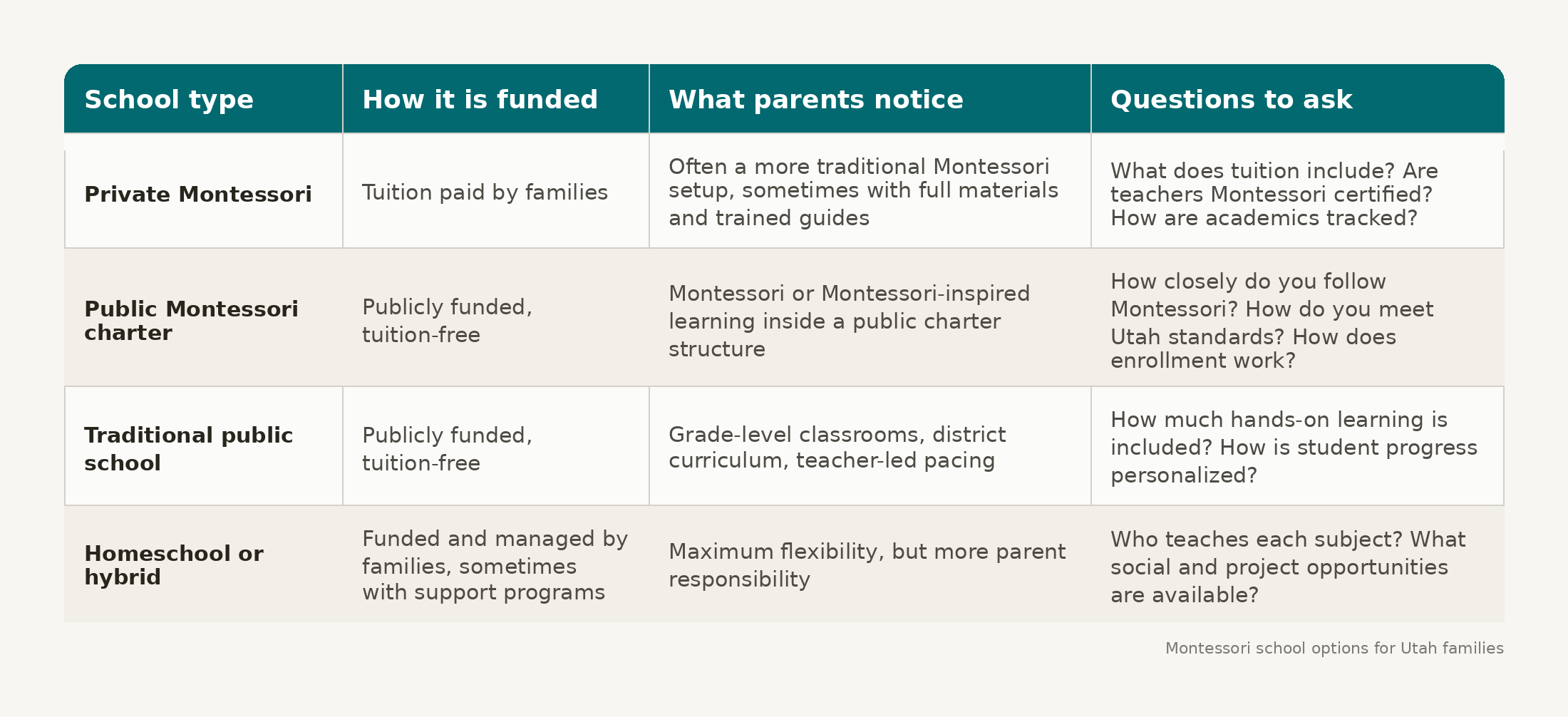
This is not about one model being good and the others being bad.
It is about fit.
Some children do beautifully in a traditional classroom with predictable routines and whole-group lessons. Some children thrive in homeschool because they need flexibility or one-on-one pacing. Some children light up in Montessori because they like movement, choice, hands-on materials, and meaningful work.
The goal is not to chase the trendiest model. The goal is to find the environment where your child can grow.
How Montessori Looks in a Public Charter School
Montessori in a public charter school can look a little different from Montessori in a private school.
In a private Montessori school, the program may follow the Montessori method very closely from preschool through elementary, including specific materials, long work cycles, and Montessori-trained guides.
In a public charter setting, Montessori principles are often blended with public school requirements, state standards, and the school’s own mission.
At Ignite, the school describes its model as a traditional Montessori model in the early grades and a blended learning model in upper grades, with project-based experiences and entrepreneurial learning woven in (Ignite Entrepreneurship Academy). Ignite’s mission page also describes Montessori foundations like mixed-age learning, concrete materials, freedom within structure, and curiosity-driven learning, alongside modern entrepreneurial skills like design thinking, value creation, communication, teamwork, and student-run businesses (Ignite Mission & Vision).
That blend is important.
It means Montessori is not treated as a museum piece. It becomes a foundation for helping students build independence, problem-solving, creativity, and real-world confidence.
For a younger child, that might look like choosing purposeful work, using hands-on math materials, caring for the classroom, practicing focus, and learning to complete a task without being rushed every few minutes.
For an older child, that same foundation might grow into project-based learning, collaboration, presentations, financial literacy, business ideas, and real-world problem-solving.
If you want a deeper comparison of Montessori and traditional classrooms, Ignite already has a helpful guide here: Montessori vs. Traditional School: A Utah County Comparison.
Why Parents Like Montessori in the First Place
Most parents are not looking for a philosophy lesson.
They are looking for a school day that makes sense for their child.
Parents are often drawn to Montessori because it feels different from the school experience they remember. Instead of rows of desks, constant transitions, and the same worksheet for everyone, Montessori classrooms are designed around purposeful work, movement, observation, and independence.
That can be especially appealing if your child:
- Likes to learn by touching and doing
- Gets frustrated by sitting still for long periods
- Wants to understand how things work
- Enjoys choosing from meaningful options
- Needs time to focus deeply
- Likes practical tasks and real-world responsibility
- Learns better when abstract ideas are made concrete
There is also credible research behind the model. A 2023 Campbell Collaboration meta-analysis reviewed 32 studies of Montessori education and found modest but meaningful positive effects on both academic and non-academic outcomes, including executive function, creativity, social-emotional skills, well-being at school, and social skills (Campbell Collaboration).
That does not mean every Montessori school is automatically strong. Implementation matters. A Montessori label by itself is not enough.
But it does suggest that the core ideas behind Montessori, especially when done well, can support both academic growth and whole-child development.
The “Freedom Within Structure” Part Is Key
One of the biggest misunderstandings about Montessori is that children just do whatever they want.
That is not the goal.
The better phrase is freedom within structure.
Students may have choices, but the choices happen inside a prepared environment. Teachers observe, guide, give lessons, redirect, and help students build responsibility over time.
For example, a child may choose which work to begin with, but they are still expected to choose purposeful work. A student may move around the room, but movement should help learning rather than distract from it. A student may work independently, but independence is coached and supported.
That balance is what many parents are really looking for.
They do not want a classroom where their child is controlled all day. They also do not want a classroom where nobody seems in charge.
They want a place where their child can become more capable.
That is why Montessori can be such a good fit for children who are ready to practice responsibility, not just receive directions.
What About Academics?
This is a fair parent question.
When a school talks about independence, creativity, entrepreneurship, or hands-on learning, some parents quietly wonder:
But will my child still learn math, reading, writing, science, and history?
They should ask that.
A strong Montessori or Montessori-inspired charter school should be able to explain how students meet academic expectations. In a public charter school, students are still part of the public education system. The model may look different, but the school should be clear about academic standards, progress monitoring, assessments, and what happens when a child needs support.
At Ignite, the school describes itself as a state-funded public charter school dedicated to teaching standards in curricular areas, with emphasis on language arts, mathematics, cultural studies, and science, while using Montessori, blended learning, and project-based experiences to shape how students learn (Ignite Entrepreneurship Academy).
That “how” matters.
In a traditional setting, a child might learn money through a worksheet.
In a Montessori-inspired or project-based setting, that child might run a small classroom store, create a budget for a project, price materials, make change, write a sign, explain the idea to classmates, and reflect on what they would do differently next time.
Both approaches can teach academic skills. The experience feels different.
For many students, that difference is the point.
How Enrollment Works
Public charter schools are tuition-free, but that does not always mean every student gets a seat immediately.
When more students apply than there are available seats, Utah charter schools generally use a lottery process. Ignite explains its current application options on the Lottery Application page, including waitlist options for the current school year and lottery applications for the upcoming school year.
This is where families sometimes get confused. Tuition-free does not mean “no application.” It means there is no tuition charge to attend.
If you are interested in a Montessori-inspired charter school, it is smart to learn the timeline early. You can also read Ignite’s guide to how Utah’s charter school lottery works.
What Parents Should Ask Before Choosing a Tuition-Free Montessori Option
When you tour or research a Montessori-inspired charter school, ask specific questions.
Broad questions get broad answers. Specific questions reveal how the school actually works.
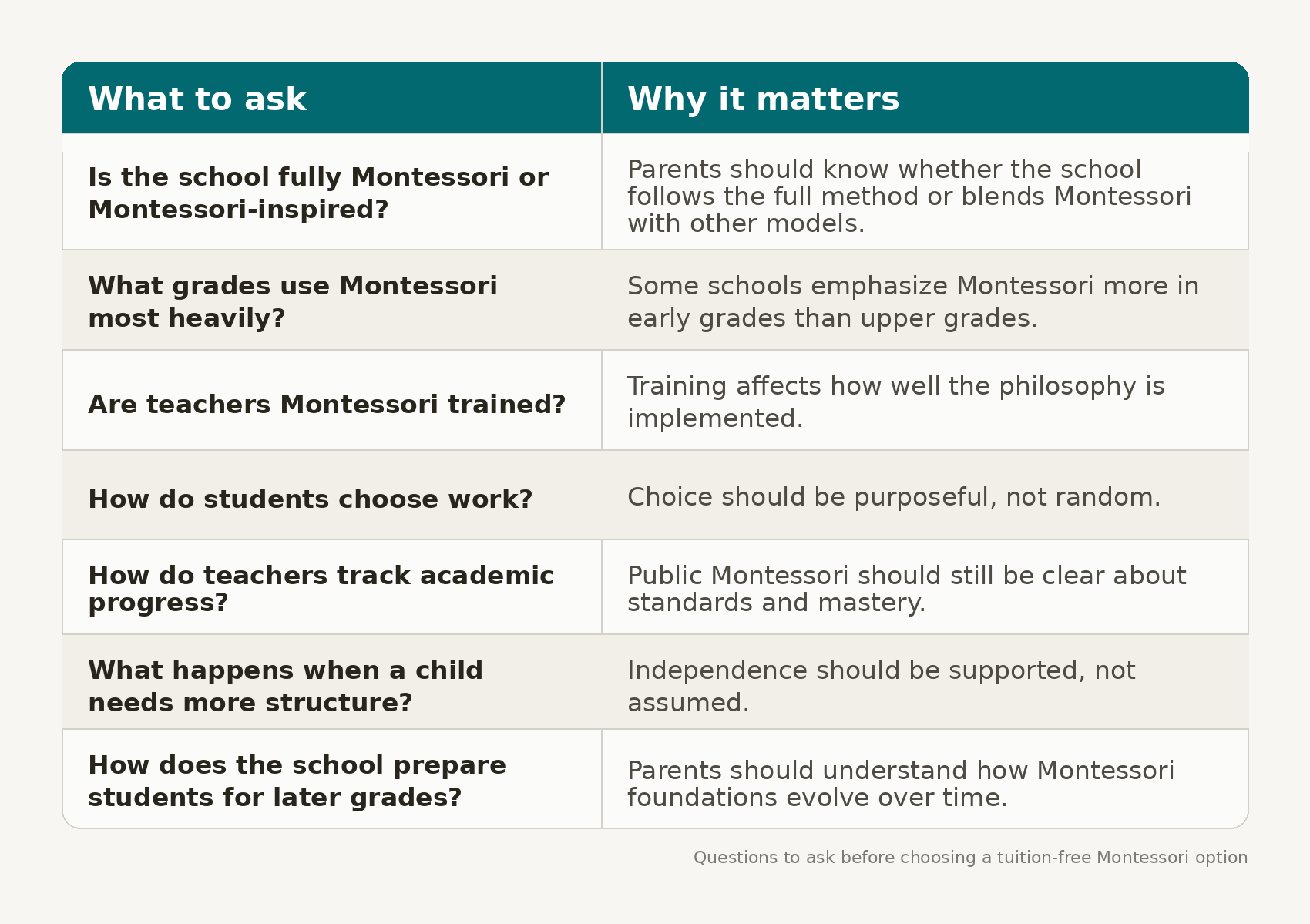
If a school can answer those questions clearly, that is a good sign.
If the answers are vague, keep asking.
Who Might Thrive in a Tuition-Free Montessori Charter School?
A Montessori-inspired charter school may be a strong fit for a child who:
- Learns best through hands-on experiences
- Likes to move while learning
- Is curious and observant
- Enjoys meaningful choices
- Benefits from calm routines
- Wants more ownership
- Likes practical, real-world work
- Needs learning to feel connected to a purpose
It may require more adjustment for a child who:
- Is used to constant teacher direction
- Feels anxious with choice
- Struggles to begin tasks independently
- Needs help organizing time
- Prefers whole-group instruction all day
That does not mean Montessori cannot work for that child. It means parents should ask how the school supports transitions, executive function, and emotional confidence.
The best schools do not expect children to arrive already independent. They teach independence.
Why This Matters for Utah County Families
Utah County families have a lot of school options. That is a gift, but it can also make the decision feel overwhelming.
In Lehi, Saratoga Springs, Eagle Mountain, Highland, Draper, and the broader Silicon Slopes area, many parents are looking for something different from a one-size-fits-all classroom. Some want more creativity. Some want less homework. Some want a calmer environment. Some want real-world learning. Some want their child to build confidence, not just complete assignments.
Ignite’s existing guide to Montessori in Utah County explains that families are often drawn to Montessori for independence, confidence, hands-on learning, calm environments, and purposeful work.
The tuition-free charter model adds one more important piece:
Access.
Families who might not be able to afford private Montessori tuition can still explore a Montessori-inspired public school option.
That can open the door for more children to experience a learning environment built around curiosity, responsibility, and real-world growth.
Final Thought
Montessori is not just a classroom style. At its best, it is a way of seeing children as capable people who can learn to make choices, solve problems, care for their environment, and take pride in meaningful work.
Private Montessori schools are one way to experience that.
Public Montessori-inspired charter schools are another.
For Utah families, the important thing is to know that tuition-free Montessori options can exist, and they are worth exploring if your child is curious, hands-on, independent, creative, or ready to become more confident in how they learn.
If you are considering Ignite, start with the school’s mission and vision, compare the model with Montessori vs. traditional school, and review the current lottery application information.
The right school choice is not just about what a school calls itself.
It is about what your child experiences there every day.
FAQ
Can Montessori be tuition-free in Utah?
Yes. Montessori can be tuition-free in Utah when it is offered through a public charter school. Utah charter schools are tuition-free public schools open to any Utah student, according to the Utah State Board of Education.
Is a public Montessori charter school the same as a private Montessori school?
Not exactly. A private Montessori school is funded through tuition and may follow the Montessori method more traditionally. A public Montessori charter school is publicly funded and tuition-free, but it may blend Montessori principles with state standards, charter requirements, and other instructional models.
Is Ignite Entrepreneurship Academy tuition-free?
Ignite is a public charter school in Lehi, Utah. Public charter schools in Utah are tuition-free public schools, and Ignite provides application information through its lottery page.
What grades use Montessori at Ignite?
Ignite describes its model as using a traditional Montessori model in the early grades and a blended learning model in upper grades, with project-based learning and entrepreneurship connected across the school (Ignite Entrepreneurship Academy).
What is the difference between Montessori and Montessori-inspired?
Montessori usually refers to a school that closely follows the Montessori method, including specific materials, classroom structure, and teacher training. Montessori-inspired schools use important Montessori principles, such as independence, hands-on work, and freedom within structure, but may blend them with other learning models.
How do I know if Montessori is right for my child?
Montessori may be a good fit if your child enjoys hands-on learning, movement, meaningful choices, practical tasks, calm routines, and growing independence. Parents should ask how the school supports children who need extra structure, academic support, or help managing time.
Ready to join IEA?
Give your child a Montessori foundation and entrepreneurial wings. Apply to the Ignite Entrepreneurship Academy enrollment lottery today.
Apply to the lottery