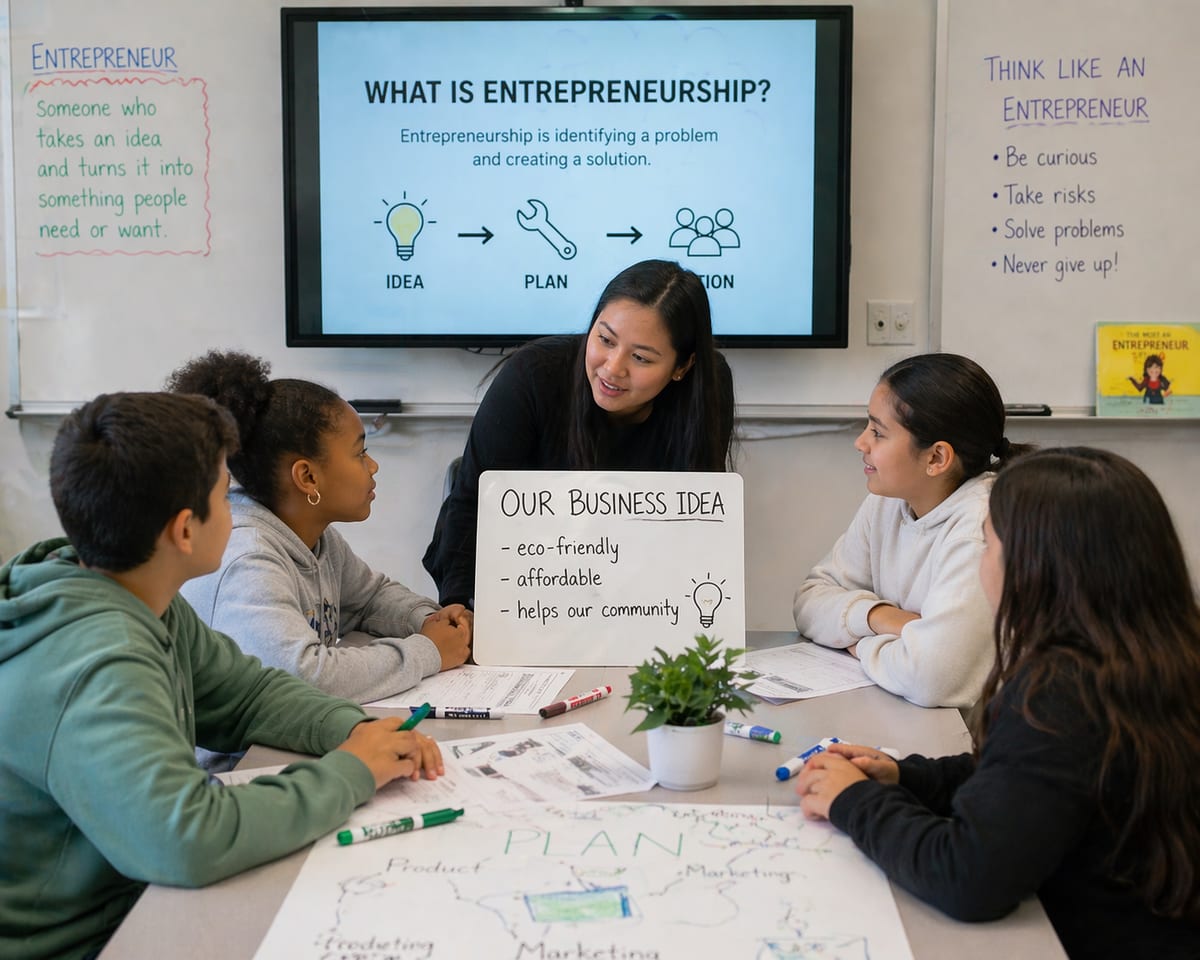
What Is Entrepreneurship Education for Kids? A Parent’s Guide to Real-World Learning
When parents hear “entrepreneurship education,” a lot of them picture a kid standing behind a lemonade stand.
That is not wrong.
A lemonade stand can teach pricing, planning, customer service, communication, and resilience. If the sign falls over, the lemonade is too sour, or nobody buys the first cup, a child gets a tiny but real lesson in problem-solving.

But entrepreneurship education is much bigger than teaching kids how to sell something.
At its best, entrepreneurship education teaches children how to notice problems, understand people’s needs, create solutions, test ideas, communicate clearly, and learn from feedback. In K-8, it is less about launching companies and more about building problem-solving, confidence, creativity, and ownership.
That is why a student can practice entrepreneurship without ever starting a “business.” They might design a better backpack hook for the classroom, create a plan for reducing lunch waste, interview classmates about a playground problem, build a prototype, present a pitch, or revise an idea after feedback.
The point is not the product.
The point is the mindset.
Entrepreneurship Education Is Not Just Business Class
For children, entrepreneurship education is really about agency.
Agency means a student starts to believe:
- I can notice a problem.
- I can ask better questions.
- I can come up with ideas.
- I can test those ideas.
- I can learn from mistakes.
- I can make something better.
- I can contribute.
That is very different from memorizing vocabulary words like “profit,” “market,” or “customer.” Those words can matter later, but they are not the heart of entrepreneurship for kids.
The heart is helping children move from “Tell me what to do” toward “I can figure out a next step.”
Ignite’s mission page describes this kind of learning through skills like understanding markets and value creation, design thinking, creative problem-solving, communication, teamwork, project management, student-run businesses, and community partnerships (Ignite Mission & Vision).
Those are not just career skills. They are life skills.
A child who can listen carefully, spot a need, try a solution, explain their thinking, and improve after feedback is practicing something useful in school, friendships, family life, and future work.
Why This Matters Now
Kids are growing up in a world where information is everywhere.
They can ask a device for a definition, a summary, a math explanation, a writing prompt, or a list of ideas. That can be helpful, but it also changes what school needs to emphasize.
If information is easy to find, students need more than information. They need judgment.
They need to know what question to ask, whether an answer makes sense, how to apply it, and what to do when the first attempt does not work.
Ignite’s post on why entrepreneurial thinking matters in the age of AI makes this same point: entrepreneurial thinking is not mainly about business, money, or startups. It is about agency, judgment, adaptability, and ownership.
That is why entrepreneurship education belongs in K-8, not just high school or college.
By the time students reach adolescence, many have already learned to wait for directions, avoid risks, and ask, “Is this what the teacher wants?” Good entrepreneurship education gently pushes against that pattern. It gives students practice thinking, choosing, testing, and revising while the stakes are still safe.
What Entrepreneurship Education Looks Like in Real Life
Here is a simple example.
A class notices that younger students are losing jackets at recess.
In a traditional assignment, students might write a paragraph about responsibility.
In an entrepreneurship-style project, they might:
- Observe where jackets get lost
- Interview younger students
- Brainstorm why the problem is happening
- Sketch possible solutions
- Build a prototype for a better classroom reminder system
- Create signs or labels
- Test the idea for a week
- Track whether fewer jackets are lost
- Present what worked and what they would change
That project could include writing, speaking, data, design, empathy, teamwork, and reflection.
It also feels real.
Students are not just completing an assignment. They are trying to improve something in their own community.
That is where entrepreneurship education becomes powerful.
What Kids Learn Through Entrepreneurship
Entrepreneurship education is useful because it blends academic skills with human skills.
Students still read, write, calculate, research, and present. But those skills are connected to a purpose.
For example:
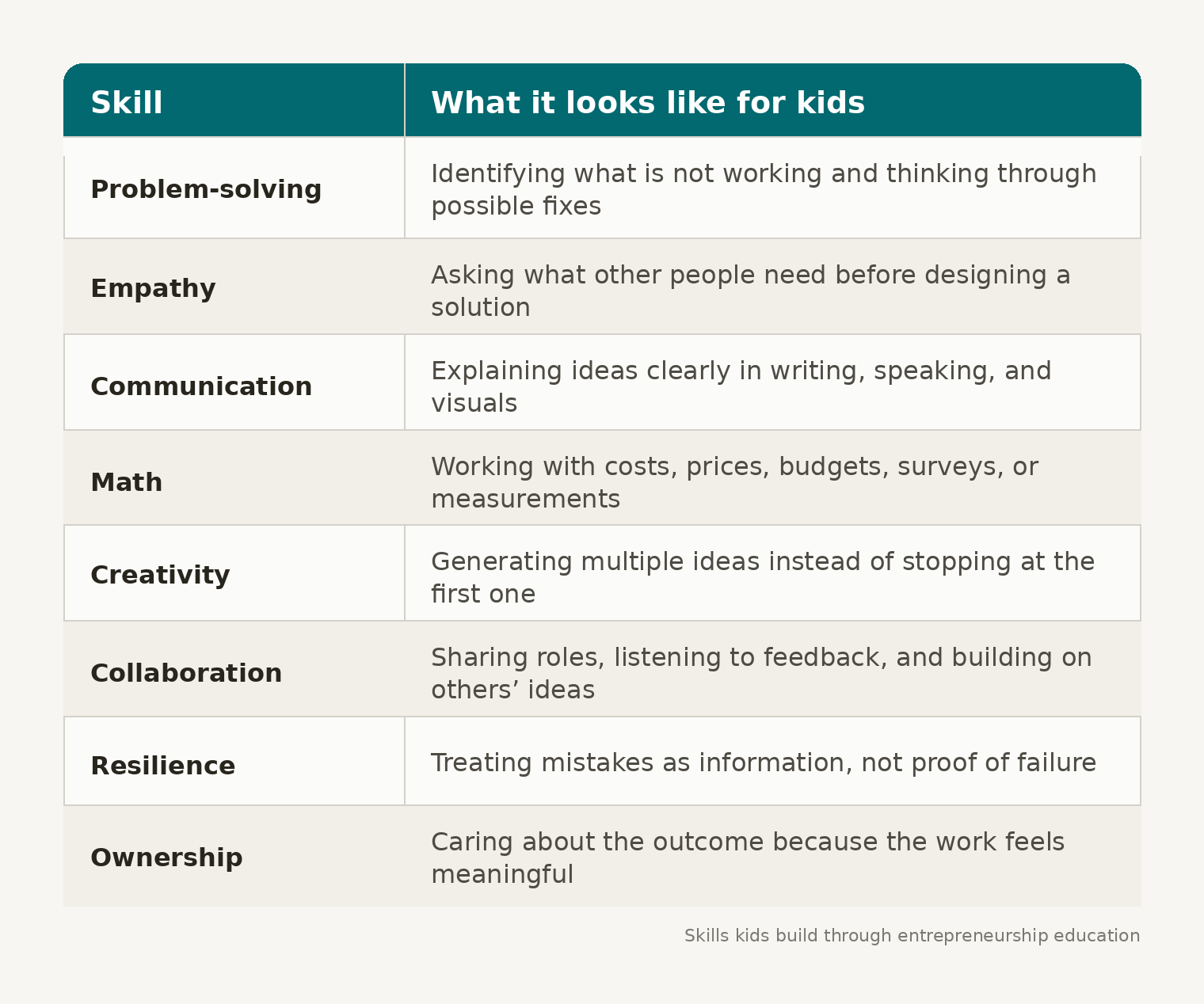
Research supports the idea that entrepreneurship education can build transferable skills. A study from the Network for Teaching Entrepreneurship found that students in entrepreneurship education showed statistically significant growth in entrepreneurial mindset, especially communication and collaboration, opportunity recognition, and critical thinking and problem-solving (NFTE).
That is the real promise.
Not every child will become a founder. Every child can benefit from learning how to think like someone who can make things better.
What It Looks Like by Grade Level
Entrepreneurship education should not look the same for a kindergartner and an eighth grader.
The mindset can start early, but the responsibility grows over time.
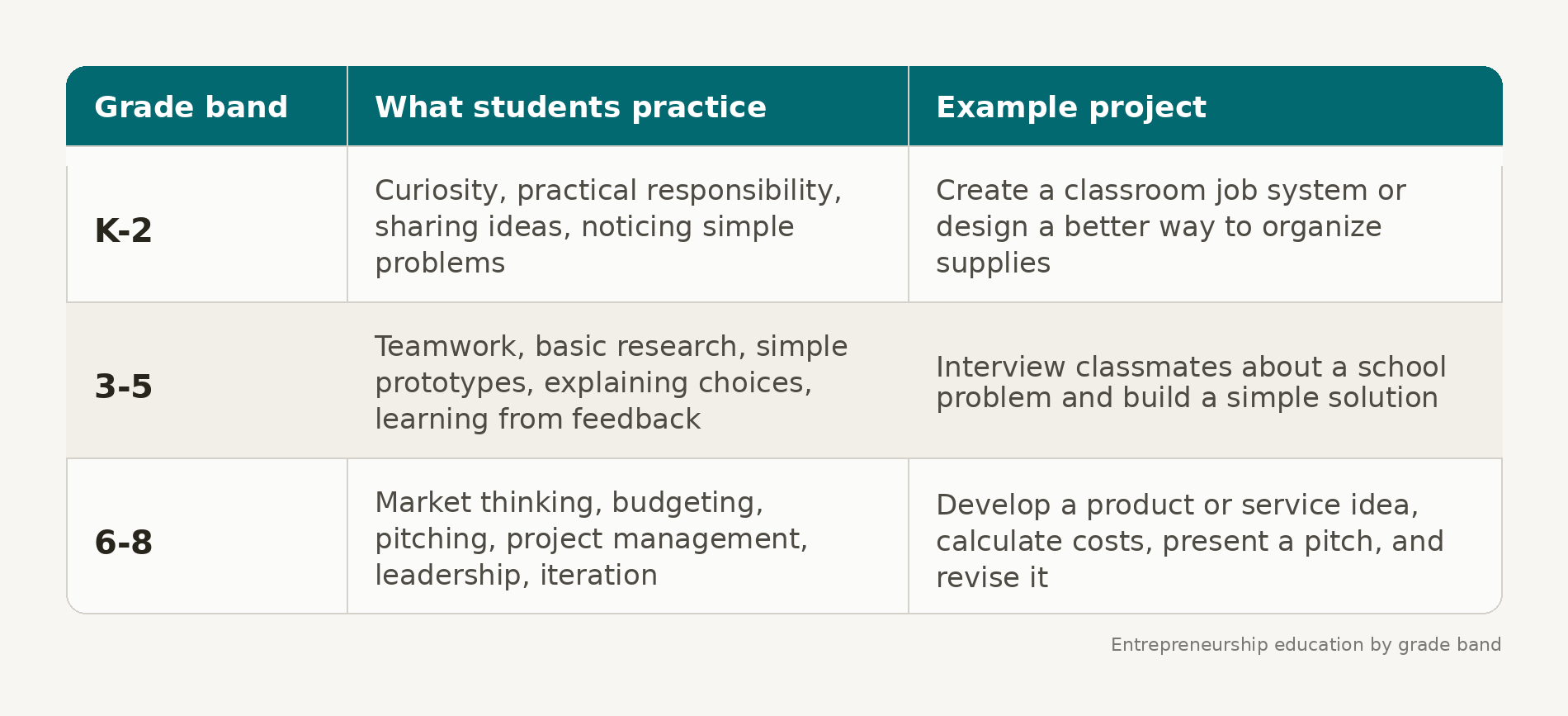
In early elementary, the work may look like practical life, classroom responsibility, simple design challenges, and learning how to explain an idea.
In upper elementary, students can begin doing more research, testing, collaboration, and presentation.
By middle school, students are ready for more structured independence. They can think about audience, cost, value, tradeoffs, and how to improve an idea after feedback.
Ignite’s 7th and 8th grade program includes entrepreneurship experiences where students develop business ideas, create plans and presentations, collaborate with peers, refine concepts through feedback, and connect academics to real-world applications (How Ignite Helps Students Build Confidence Through Entrepreneurship).
Why Design Thinking Fits So Well
A lot of entrepreneurship education overlaps with design thinking.
Design thinking is a problem-solving process that usually includes understanding people’s needs, defining the problem, brainstorming ideas, prototyping, testing, and improving.
That process is helpful for kids because it slows them down.
Instead of jumping straight to “I have an idea,” students learn to ask:
- Who has the problem?
- What do they actually need?
- What have we observed?
- What could we try?
- How will we know if it worked?
- What feedback did we get?
- What should we change?
Those questions build empathy and clearer thinking.
One study of a design thinking model in class found that it fostered mindsets such as empathy, holistic thinking, problem reframing, and teamwork among students (ERIC).
For younger students, design thinking can be as simple as noticing that classmates struggle to carry art projects home and designing a better folder. For older students, it can become a more advanced project involving interviews, budgets, prototypes, and a public pitch.
The pattern is the same:
Notice. Ask. Create. Test. Improve.
The Role of Failure
Entrepreneurship education works best when students are allowed to experience small failures.
Not harmful failures. Not humiliating failures. Just normal, useful ones.
The prototype tips over. The survey question is confusing. The pitch is too long. The budget does not add up. The first design does not solve the real problem.
Those moments are where students learn.
In many school assignments, mistakes feel final. In entrepreneurial learning, mistakes are part of the process.
A student learns to say:
“That did not work yet.”
That one word, “yet,” is doing a lot of work.
It helps students separate the result from their identity. The failed prototype does not mean the student is bad at science, math, writing, or leadership. It means the idea needs another round.
That is a lesson students can carry into high school, work, relationships, and adulthood.
How Entrepreneurship Connects to Academics
Some parents hear “entrepreneurship” and worry it might replace academics.
It should not.
Done well, entrepreneurship education gives academics somewhere to go.
Writing matters when students need to explain a product idea clearly. Math matters when they are calculating costs, pricing, profit, measurements, or survey results. Reading matters when they research a problem or compare solutions. Speaking matters when they pitch. Science matters when they test materials. Social studies matters when they think about community needs.
For example, a student market project might include:
- Math: cost, pricing, revenue, profit, percentages
- Writing: product descriptions, signs, reflection, pitch scripts
- Reading: research, instructions, examples, customer feedback
- Speaking: presentations, sales conversations, peer feedback
- Art/design: branding, packaging, layout
- Social skills: teamwork, listening, responsibility
That is why many students remember this kind of learning. It gives academic skills a job.
Ignite’s guide to project-based learning explains that PBL helps students apply what they learn through meaningful, real-world projects that require thinking, creating, and problem-solving.
Entrepreneurship education is a natural partner to that.
What Parents Should Look For
If a school says it teaches entrepreneurship, ask what students actually do.
A strong program should include more than posters about leadership or a one-time business fair.
Look for:
- Real problems students can understand
- Student choice within clear structure
- Opportunities to interview, observe, or research
- Prototypes, drafts, or models
- Feedback from teachers, peers, parents, or community members
- Presentations or exhibitions
- Reflection on what worked and what changed
- Academic connections to reading, writing, math, science, or social studies
Ask questions like:
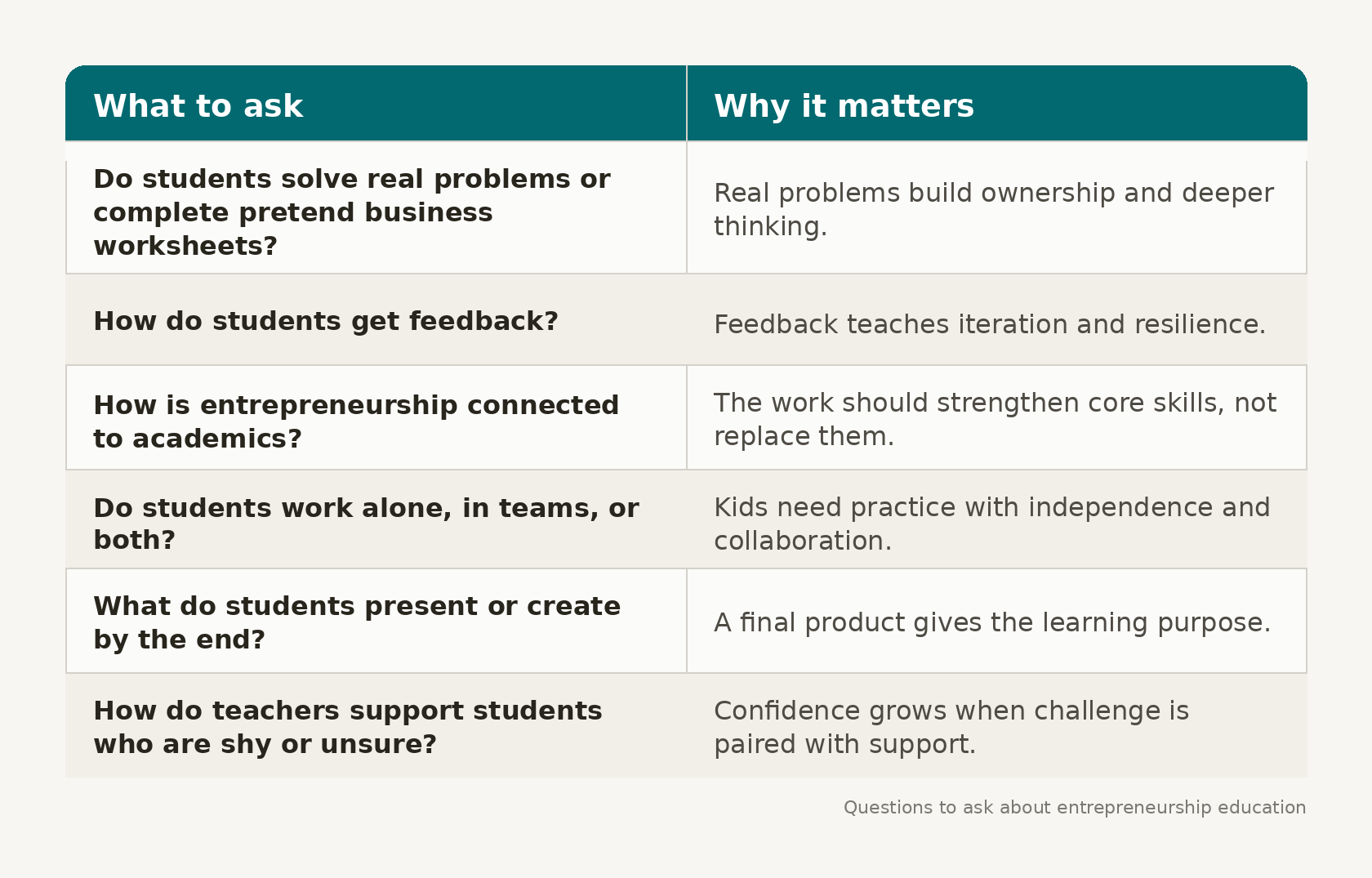
Good entrepreneurship education should feel active, structured, and meaningful.
It should not feel like adults are pretending every child needs to be a CEO.
What Parents Can Do at Home
Parents do not need a business degree to encourage entrepreneurial thinking.
You can start with everyday moments.
If your child complains about a problem, ask:
“What do you think would make it better?”
If they want to buy something, ask:
“How could you earn, save, or plan for that?”
If a project fails, ask:
“What did you learn that you can use next time?”
If they have a big idea, ask:
“Who would this help?”
If they get stuck, ask:
“What is one small test you could try?”
These questions teach children to move from frustration to action.
That is entrepreneurship in its simplest form.
Why Ignite Focuses on Entrepreneurship
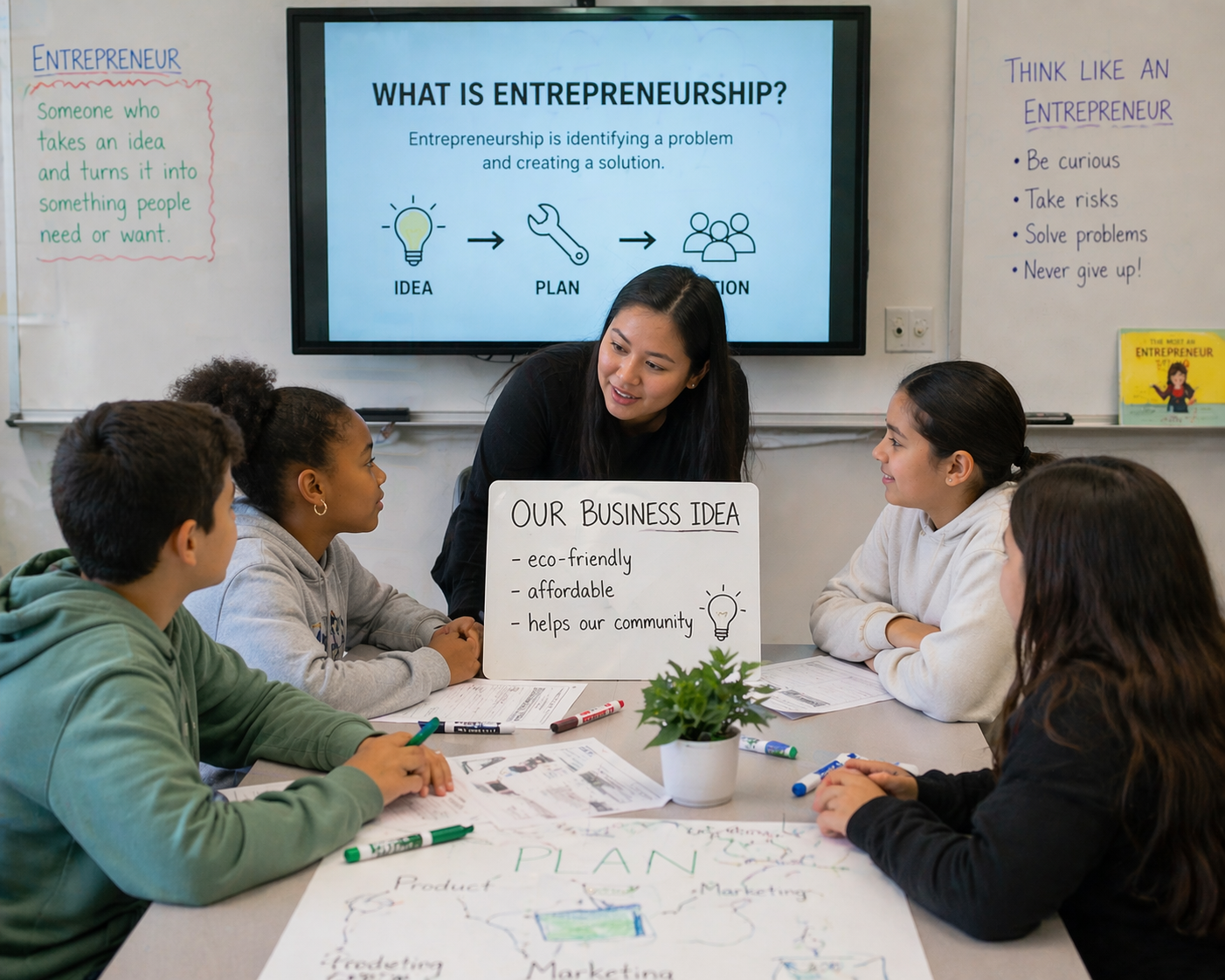
Ignite is not using “entrepreneurship” as a buzzword. It is part of the school’s identity.
The school’s mission is “Igniting the next generation of entrepreneurs,” and its model combines Montessori roots with entrepreneurial skills such as design thinking, creative problem-solving, communication, teamwork, project management, student-run businesses, and community partnerships (Ignite Mission & Vision).
That combination makes sense.
Montessori helps students build independence and purposeful work. Project-based learning helps students apply knowledge to meaningful challenges. Entrepreneurship helps students take the next step: noticing opportunities, creating value, and learning through action.
Together, those ideas support a child who is not just trying to get through school, but learning how to think, contribute, and adapt.
Final Thought
Entrepreneurship education for kids is not about rushing childhood or turning every student into a startup founder.
It is about giving children meaningful chances to practice initiative.
The world will keep changing. Tools will change. Jobs will change. Technology will change.
But children who can notice problems, ask thoughtful questions, create solutions, communicate clearly, work with others, and learn from feedback will have skills they can use almost anywhere.
That is why entrepreneurship education belongs in K-8.
Not because every child needs to start a company.
Because every child deserves to know they can make things better.
FAQ
What is entrepreneurship education for kids?
Entrepreneurship education for kids teaches students how to notice problems, understand people’s needs, create solutions, test ideas, communicate clearly, and learn from feedback. It is more about mindset and problem-solving than starting a business.
Is entrepreneurship education just business class?
No. Business concepts can be part of entrepreneurship education, especially in older grades, but the main goal is to build initiative, creativity, problem-solving, communication, collaboration, resilience, and ownership.
What age should entrepreneurship education start?
Entrepreneurial thinking can start in early elementary school through simple projects, classroom responsibilities, problem-solving conversations, and opportunities for choice. The work should become more complex as students mature.
How does entrepreneurship education help academics?
Entrepreneurship projects can strengthen writing, math, reading, speaking, research, science, and social studies by giving students a real purpose for using those skills.
What does entrepreneurship look like in middle school?
In middle school, students may develop product or service ideas, calculate costs, research an audience, build prototypes, create presentations, pitch ideas, and revise based on feedback.
Is entrepreneurship education a good fit for shy students?
It can be, if the school provides enough support. Shy students can build confidence through small presentations, team roles, rehearsed pitches, peer feedback, and opportunities to contribute in ways that feel safe before taking bigger risks.
Ready to join IEA?
Give your child a Montessori foundation and entrepreneurial wings. Apply to the Ignite Entrepreneurship Academy enrollment lottery today.
Apply to the lottery